
|
You entered: ring
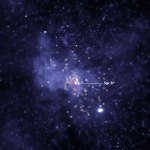 A Plurality of Singularities at the Galactic Center
11.05.2018
A recent informal poll found that astronomers don't yet have a good collective noun for a group of black holes, but they need one. The red circles in this Chandra Observatory X-ray image identify a group of a dozen black holes that are members of binary star systems.
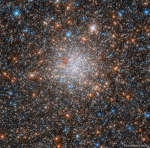 NGC 1898: Globular Cluster in the LMC
2.10.2018
Jewels don't shine this bright -- only stars do. And almost every spot in this glittering jewel-box of an image from the Hubble Space Telescope is a star. Now some stars are more red than our Sun, and some more blue -- but all of them are much farther away.
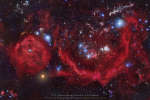 The Orion You Can Almost See
20.08.2019
Do you recognize this constellation? Although it is one of the most recognizable star groupings on the sky, this is a more full Orion than you can see -- an Orion only revealed with long exposure digital camera imaging and post-processing.
 Stickney Crater
7.07.2023
Stickney Crater, the largest crater on the martian moon Phobos, is named for Chloe Angeline Stickney Hall, mathematician and wife of astronomer Asaph Hall. Asaph Hall discovered both the Red Planet's moons in 1877.
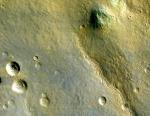 Mars: The View from HiRISE
10.04.2006
HiRISE - the High Resolution Imaging Science Experiment - rides on the Mars Reconnaissance Orbiter (MRO)spacecraft just arrived in Mars orbit on March 10. This sharp view of the martian surface from the HiRISE camera includes image data with a full resolution of about 2.5 meters per pixel - recorded from a range of 2,500 kilometers.
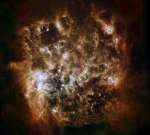 Infrared Portrait of the Large Magellanic Cloud
15.01.2012
Cosmic dust clouds ripple across this infrared portrait of our Milky Way's satellite galaxy, the Large Magellanic Cloud. In fact, the remarkable composite image from the Herschel Space Observatory and the Spitzer Space Telescope show that dust clouds fill this neighboring dwarf galaxy, much like dust along the plane of the Milky Way itself.
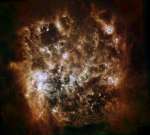 Infrared Portrait of the Large Magellanic Cloud
23.03.2013
Cosmic dust clouds ripple across this infrared portrait of our Milky Way's satellite galaxy, the Large Magellanic Cloud. In fact, the remarkable composite image from the Herschel Space Observatory and the Spitzer Space Telescope show that dust clouds fill this neighboring dwarf galaxy, much like dust along the plane of the Milky Way itself.
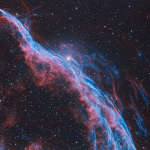 NGC 6960: The Witch s Broom Nebula
29.05.2013
Ten thousand years ago, before the dawn of recorded human history, a new light would have suddenly have appeared in the night sky and faded after a few weeks. Today we know this light was from a supernova, or exploding star, and record the expanding debris cloud as the Veil Nebula, a supernova remnant.
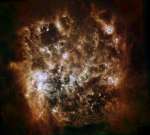 Infrared Portrait of the Large Magellanic Cloud
13.01.2016
Cosmic dust clouds ripple across this infrared portrait of our Milky Way's satellite galaxy, the Large Magellanic Cloud. In fact, the remarkable composite image from the Herschel Space Observatory and the Spitzer Space Telescope show that dust clouds fill this neighboring dwarf galaxy, much like dust along the plane of the Milky Way itself.
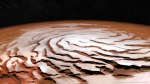 The Spiral North Pole of Mars
18.12.2017
Why is there a spiral around the North Pole of Mars? Each winter this pole develops a new outer layer about one meter thick composed of carbon dioxide frozen out of the thin Martian atmosphere. This fresh layer is deposited on a water-ice layer that exists year round.
|
January February March April May June July August September October |
|||||||||||||||||||||||||||||||||||||||||||||||||