
|
You entered: light
 Orion in Depth
18.09.2020
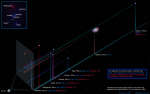
Orion is a familiar constellation. The apparent positions of its stars in two dimensions create a well-known pattern on the bowl of planet Earth's night sky. Orion may not look quite so familiar in this 3D view though.
 The Small Cloud of Magellan
4.01.2021
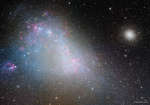
What is the Small Magellanic Cloud? It has turned out to be a galaxy. People who have wondered about this little fuzzy patch in the southern sky included Portuguese navigator Ferdinand Magellan...
 Perseids and MAGIC
10.08.2022
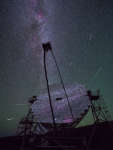
On August 11, 2021 a multi-mirror, 17 meter-diameter MAGIC telescope reflected this starry night sky from the Roque de los Muchachos European Northern Observatory on the Canary Island of La Palma. MAGIC stands for Major Atmospheric Gamma Imaging Cherenkov.
 Stargate Milky Way
16.08.2022
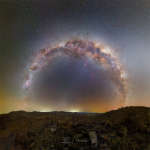
There is a huge gate of stars in the sky, and you pass through it twice a day. The stargate is actually our Milky Way Galaxy, and it is the spin of the Earth that appears to propel you through it.
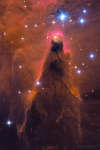 APOD: 2023 January 10 Б NGC 2264: The Cone Nebula
9.01.2023
Stars are forming in the gigantic dust pillar called the Cone Nebula. Cones, pillars, and majestic flowing shapes abound in stellar nurseries where clouds of gas and dust are sculpted by energetic winds from newborn stars. The Cone Nebula, a well-known example, lies within the bright galactic star-forming region NGC 2264.
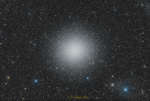 Globular Cluster Omega Centauri
10.07.2024
Globular star cluster Omega Centauri packs about 10 million stars much older than the Sun into a volume some 150 light-years in diameter. Also known as NGC 5139, at a distance...
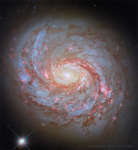 APOD: 2025 December 2 Б M77: Spiral Galaxy with an Active Center
1.12.2025
What's happening in the center of nearby spiral galaxy M77? The face-on galaxy lies a mere 47 million light-years away toward the constellation of the Sea Monster (Cetus). At that estimated distance, this gorgeous island universe is about 100 thousand light-years across.
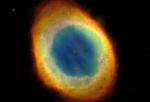 M57: The Ring Nebula
21.03.2003
Except for the rings of Saturn, the Ring Nebula (M57) is probably the most famous celestial band. This planetary nebula's simple, graceful appearance is thought to be due to perspective -- our view from planet Earth looking straight into what is actually a barrel-shaped cloud of gas shrugged off by a dying central star.
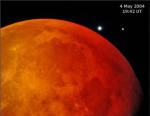 Zubenelgenubi and Friends
14.05.2004
Moderately bright Zubenelgenubi is the star just off the upper right hand limb of an eclipsed Moon in this telescopic view from Port Elizabeth, South Africa. Actually the second brightest star in the constellation...
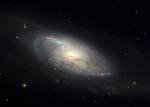 M106 in Canes Venatici
30.07.2005
Close to the Great Bear (Ursa Major) and surrounded by the stars of the Hunting Dogs (Canes Venatici), this celestial nebula was discovered in 1781 by the metric French astronomer Pierre Mechain. Later, it was added to the catalog of his friend and colleague Charles Messier as M106.
|
January February March April May June July August September October |
|||||||||||||||||||||||||||||||||||||||||||||||||