
|
You entered: light
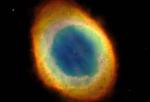 M57: The Ring Nebula
4.07.2004
Except for the rings of Saturn, the Ring Nebula (M57) is probably the most famous celestial band. This planetary nebula's simple, graceful appearance is thought to be due to perspective -- our view from planet Earth looking straight into what is actually a barrel-shaped cloud of gas shrugged off by a dying central star.
 The Case of the Missing Supernova
13.04.1999
Would you notice a second Moon in the sky? About 700 years ago, light from a tremendous explosion reached Earth that should have appeared almost as bright as a full Moon. The bright spot should have lasted for weeks, yet no notation of such an occurrence has been found in historical records.
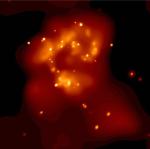 X-Rays From Antennae Galaxies
18.08.2000
A bevy of black holes and neutron stars shine as bright, point-like sources against bubbles of million degree gas in this false-color x-ray image from the orbiting Chandra Observatory. The striking picture shows...
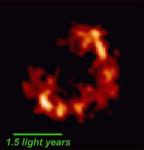 Supernova Remnant In M82
16.12.1999
This false-color radio wavelength picture of an expanding stellar debris cloud is the product of one of the largest radio astronomy experiments ever. Combining the output of 20 radio telescopes scattered around planet Earth...
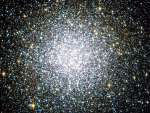 APOD: 2008 April 2- Globular Cluster M55 from CFHT
2.04.2008
The fifty-fifth entry in Charles Messier's catalog, M55 is a large and lovely globular cluster of around 100,000 stars. Only 20,000 light-years away in the constellation Sagittarius, M55 appears to earth-bound observers to be nearly 2/3 the size of the full moon.
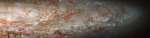 NGC 253 Close Up
2.10.2008
This dusty island universe is one of the brightest spiral galaxies in the sky. Seen nearly edge-on, NGC 253 lies a mere 13 million light-years away and is the largest member of the Sculptor Group of galaxies, neighbor to our own local galaxy group.
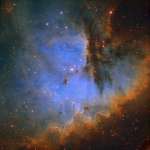 NGC 281
10.12.2008
Look through the cosmic cloud cataloged as NGC 281 and it's almost easy to miss stars of the open cluster IC 1590. But, formed within the nebula, that cluster's young, massive stars ultimately power the pervasive nebular glow.
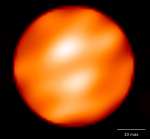 The Spotty Surface of Betelgeuse
6.01.2010
Betelgeuse really is a big star. If placed at the center of our Solar System it would extend to the orbit of Jupiter. But like all stars except the Sun, Betelgeuse is so distant it usually appears as a single point of light, even in large telescopes.
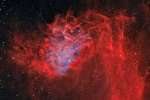 AE Aurigae and the Flaming Star Nebula
11.03.2011
AE Aurigae is the bright star below and left of center in this evocative portrait of IC 405, also known as the Flaming Star Nebula. Embedded in the cosmic cloud, the hot, variable O-type star energizes the glow of hydrogen along convoluted filaments of atomic gas, its blue starlight scattered by interstellar dust.
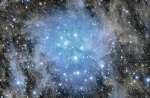 Pleiades Deep Field
21.09.2011
Have you ever seen the Pleiades star cluster? Even if you have, you probably have never seen it like this: all dusty. Perhaps the most famous star cluster on the sky, the bright stars of the Pleiades can be seen without binoculars from even the depths of a light-polluted city.
|
January February March April May June July August September October |
|||||||||||||||||||||||||||||||||||||||||||||||||