
|
You entered: light
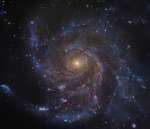 Messier 101
15.04.2011
Big, beautiful spiral galaxy M101 is one of the last entries in Charles Messier's famous catalog, but definitely not one of the least. About 170,000 light-years across, this galaxy is enormous, almost twice the size of our own Milky Way galaxy.
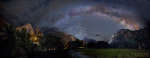 That Night over Half Dome
2.05.2014
Captured one night last May this eight frame mosaic starts on the left, down Northside Drive through Yosemite National Park. It ends thousands of light-years away though, as the arc of the Milky Way tracks toward the center of our galaxy on the right, far beyond the park's rugged skyline.
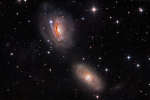 Unraveling NGC 3169
6.11.2015
Spiral galaxy NGC 3169 appears to be unraveling in this cosmic scene, played out some 70 million light-years away just below bright star Regulus toward the faint constellation Sextans. Its beautiful spiral arms...
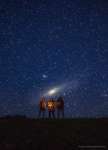 Andromeda Rising over Colombia
19.04.2016
Whats that rising over the hill? A galaxy. Never having seen a galaxy themselves, three friends of an industrious astrophotographer experienced an exhilarating night sky firsthand that featured not only the band of our Milky Way galaxy but also Milky Way's neighbor -- the Andromeda galaxy.
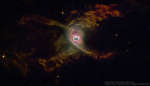 The Red Spider Planetary Nebula
19.04.2017
Oh what a tangled web a planetary nebula can weave. The Red Spider Planetary Nebula shows the complex structure that can result when a normal star ejects its outer gases and becomes a white dwarf star.
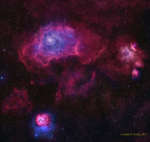 A Sagittarius Triplet
27.07.2017
These three bright nebulae are often featured on telescopic tours of the constellation Sagittarius and the crowded starfields of the central Milky Way. In fact, 18th century cosmic tourist Charles Messier cataloged two of them; M8, the large nebula above and left of center, and colorful M20 near the bottom of the frame.
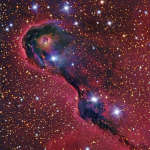 An Elephant s Trunk in Cepheus
16.01.2018
With image data from telescopes large and small, this close-up features the dusty Elephant's Trunk Nebula. It winds through the emission nebula and young star cluster complex IC 1396, in the high and far off constellation of Cepheus. Also known as vdB 142, the cosmic elephant's trunk is over 20 light-years long.
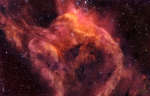 NGC 3572 and the Southern Tadpoles
6.05.2022
This cosmic skyscape features glowing gas and dark dust clouds along side the young stars of NGC 3572. A beautiful emission nebula and star cluster it sails far southern skies within the nautical constellation Carina.
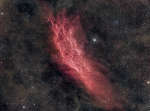 NGC 1499: The California Nebula
22.10.2022
Drifting through the Orion Arm of the spiral Milky Way Galaxy, this cosmic cloud by chance echoes the outline of California on the west coast of the United States. Our own Sun also lies within the Milky Way's Orion Arm, only about 1,500 light-years from the California Nebula.
 APOD: 2025 July 29 Б A Helix Nebula Deep Field
29.07.2025
Is the Helix Nebula looking at you? No, not in any biological sense, but it does look quite like an eye. The Helix Nebula is so named because it also appears that you are looking down the axis of a helix.
|
January February March April May June July August September October |
|||||||||||||||||||||||||||||||||||||||||||||||||