
|
You entered: light
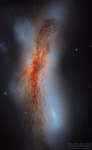 NGC 520: Colliding Galaxies from Hubble
7.09.2021
Is this one galaxy or two? The jumble of stars, gas, and dust that is NGC 520 is now thought to incorporate the remains of two separate disk galaxies. A defining component...
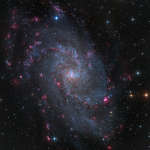 M33: The Triangulum Galaxy
12.11.2021
The small, northern constellation Triangulum harbors this magnificent face-on spiral galaxy, M33. Its popular names include the Pinwheel Galaxy or just the Triangulum Galaxy. M33 is over 50,000 light-years in diameter, third largest in the Local Group of galaxies after the Andromeda Galaxy (M31), and our own Milky Way.
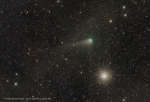 Messier 10 and Comet
21.07.2022
Imaged on July 15 2022, comet C/2017 K2 (PanSTARRS) had a Messier moment, sharing this wide telescopic field of view with globular star cluster Messier 10. Of course M10 was cataloged by 18th century comet hunter Charles Messier as the 10th object on his list of things that were definitely not comets.
 Trapezium: At the Heart of Orion
5.01.2024
Near the center of this sharp cosmic portrait, at the heart of the Orion Nebula, are four hot, massive stars known as the Trapezium. Gathered within a region about 1.5 light-years in radius, they dominate the core of the dense Orion Nebula Star Cluster.
 APOD: 2024 August 6 Б Storm Cloud Over Texas
6.08.2024
What makes this storm cloud so colorful? First, the cloud itself is composed of millions of tiny droplets of water and ice. Its bottom is almost completely flat -- but this isn't unusual. Bottom...
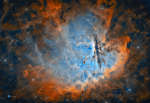 APOD: 2025 March 26 Б Star Formation in the Pacman Nebula
26.03.2025
You'd think the Pacman Nebula would be eating stars, but actually it is forming them. Within the nebula, a cluster's young, massive stars are powering the pervasive nebular glow. The eye-catching shapes...
 APOD: 2025 September 10 Б The Great Lacerta Nebula
10.09.2025
It is one of the largest nebulas on the sky -- why isn't it better known? Roughly the same angular size as the Andromeda Galaxy, the Great Lacerta Nebula can be found toward the constellation of the Lizard (Lacerta).
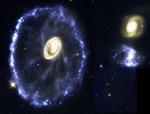 Cartwheel of Fortune
23.02.1997
By chance, a collision of two galaxies has created a surprisingly recognizable shape on a cosmic scale - "The Cartwheel Galaxy". The Cartwheel is part of a group of galaxies about 500 million light years away in the constellation of Sculptor (two smaller galaxies in the group are visible on the right).
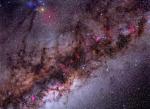 Our Galaxy in Stars, Gas, and Dust
28.09.2003
The disk of our Milky Way Galaxy is home to hot nebulae, cold dust, and billions of stars. The red nebulae visible in the above contrast-enhanced picture are primarily emission nebulae, glowing clouds of hydrogen gas heated by nearby, bright, young stars.
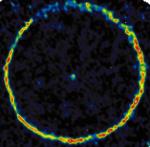 TT Cygni: Carbon Star
18.12.1998
TT Cygni is a cool red giant star with a wind. This false-color picture of TT Cyg was made using a coordinated array of millimeter wavelength radio telescopes and shows radio emission from carbon monoxide (CO) molecules in the surrounding gas.
|
January February March April May June July August September October |
|||||||||||||||||||||||||||||||||||||||||||||||||