
|
You entered: planets
 A Year of New Perspectives
28.12.1999
Fittingly, 1999 saw a decade of astronomical discoveries to an end with portents of things to come - embodied in new spacecraft, telescopes, and perspectives to explore the distant Universe across the electromagnetic spectrum. X-ray astronomy in particular will likely flourish in coming
 A Landing On Mars
4.07.1997
Today, July 4th, at about 10:00 AM Pacific Daylight Time (PDT), the Mars Pathfinder spacecraft will land on Mars. Ninety minutes before reaching the surface Pathfinder will begin a flurry of activity.
 Titan Landscape
17.01.2005
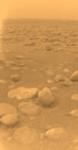
This color view from Titan gazes across a suddenly familiar but distant landscape on Saturn's largest moon. The scene was recorded by ESA's Huygens probe after a 2 1/2 hour descent through a thick atmosphere of nitrogen laced with methane.
 In the Shadow of Saturn
4.09.2011
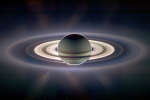
In the shadow of Saturn, unexpected wonders appear. The robotic Cassini spacecraft now orbiting Saturn drifted in giant planet's shadow for about 12 hours in 2006 and looked back toward the eclipsed Sun. Cassini saw a view unlike any other.
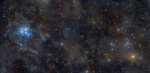 Pleiades to Hyades
17.11.2011
This cosmic vista stretches almost 20 degrees across the gentle constellation Taurus. It begins at the Pleiades and ends at the Hyades, two of the best known star clusters in planet Earth's sky. At left, the lovely Pleiades star cluster is about 400 light-years away.
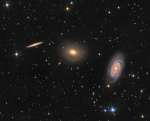 Three Galaxies in Draco
16.10.2013
This intriguing trio of galaxies is sometimes called the Draco Group, located in the northern constellation of (you guessed it) Draco. From left to right are edge-on spiral NGC 5981, elliptical galaxy NGC 5982...
 ISS Double Transit
12.09.2015
Not once, but twice the International Space Station transits the Sun on consecutive orbits of planet Earth in this video frame composite. The scene was captured on August 22 from a single well-chosen location in Schmalenbeck, Germany where the ISS created intersecting shadow paths only around 7 kilometers wide.
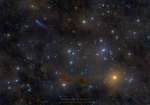 Blue Comet in the Hyades
18.01.2018
Stars of the Hyades cluster are scattered through this mosaic spanning over 5 degrees on the sky toward the constellation Taurus. Presently cruising through the Solar System, the remarkably blue comet C/2016 R2 PanSTARRS is placed in the wide field of view using image data from January 12.
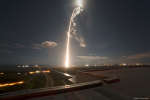 Launch of the Solar Orbiter
11.02.2020
How does weather on the Sun affect humanity? To help find out, the European Space Agency (ESA) and NASA have just launched the Solar Orbiter. This Sun-circling robotic spaceship will monitor...
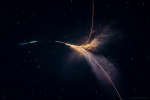 Falcon 9 Boostback
12.03.2020
Short star trails appear in this single 84 second long exposure, taken on March 6 from a rotating planet. The remarkable scene also captures the flight of a Falcon 9 rocket and Dragon cargo spacecraft over Cape Canaveral Air Force Station shortly after launch, on a resupply mission bound for the International Space Station.
|
January February March April May June July August September October |
|||||||||||||||||||||||||||||||||||||||||||||||||