
|
You entered: planets
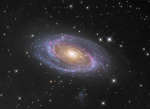 Messier 81
12.03.2021
One of the brightest galaxies in planet Earth's sky is similar in size to our Milky Way Galaxy: big, beautiful Messier 81. Also known as NGC 3031 or Bode's galaxy for its 18th century discoverer, this grand spiral can be found toward the northern constellation of Ursa Major, the Great Bear.
 APOD: 2025 June 26 Б The Seagull Nebula
26.06.2025
An interstellar expanse of glowing gas and obscuring dust presents a bird-like visage to astronomers from planet Earth, suggesting its popular moniker, the Seagull Nebula. This broadband portrait of the cosmic bird covers...
 Orion and the Ocean of Storms
13.12.2025
On December 5, 2022, a camera on board the uncrewed Orion spacecraft captured this view as Orion approached its return powered flyby of the Moon. Beyond one of Orion's extended solar arrays lies dark, smooth, terrain along the western edge of the Oceanus Procellarum.
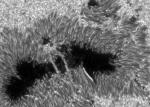 Light Bridges on the Sun
22.05.2000
Bridges the length of a planet can form on the Sun in a matter of hours. Known as light bridges, these structures may form as large sunspot groups decay. Above, one of the sharpest photographs of the Sun ever taken shows two such light bridges that appeared late last month.
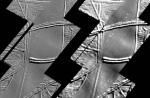 Folding Europa
25.08.2000
Astypalaea Linea on Jovian ice moon Europa is the broad smooth region running through these images recorded by the Galileo spacecraft in 1998. The pictures are different computer processed versions of the same mosaic -- on the left, small scale details have been enhanced while on the right, large scale features are emphasized.
 Perseids of Summer
10.08.2001
Like falling stardust, cast off bits of comet Swift-Tuttle hurtle through the upper atmosphere about this time each year as planet Earth passes near the comet's orbital path. For the northern hemisphere, this...
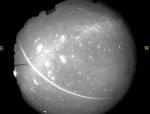 A 2001 Leonids Meteor Shower Fireball
19.11.2001
The 2001 Leonids Meteor Shower gave quite a show to many parts of the world yesterday during the early morning hours. Many sleepy observers venturing into their own backyards were treated to several bright meteors per minute streaking across the sky.
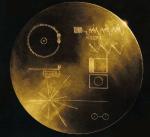 The Voyagers' Message in a Bottle
31.08.2002
Launched twenty-five years ago, NASA's Voyager 1 and 2 spacecraft are now over 10 billion kilometers from the Sun. Still operational, the Voyagers are being tracked and commanded through the Deep Space Network.
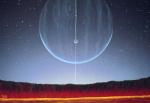 A Year of Assessing Astronomical Hazards
31.12.2002
Could an asteroid destroy civilization on Earth? Mountain-sized space rocks could potentially impact the Earth causing global effects, and perhaps even be mistaken for a nuclear blast of terrestrial origin. Such large impacts are rare but have happened before. Modern telescopes have therefore begun to scan the skies for signs of approaching celestial hazards.
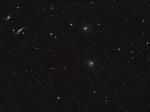 Stars, Galaxies, and Comet Tempel 1
12.05.2005
Faint comet Tempel 1 sports a fuzzy blue-tinted tail, just right of center in this lovely field of stars. Recorded on May 3rd slowly sweeping through the constellation Virgo, periodic comet Tempel 1 orbits the Sun once every 5.5 years.
|
January February March April May June July August September October |
|||||||||||||||||||||||||||||||||||||||||||||||||