
|
You entered: color
 The South Pole of Mars
12.12.2001
The south pole of Mars is the bright area near the center of the detailed, subtly shaded color image above. Recorded in September of this year by the Mars Global Surveyor (MGS) spacecraft, the picture shows a region surrounding the 400 kilometer wide martian polar cap in the midst of southern hemisphere spring.
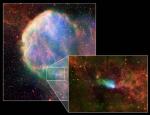 IC 443: Supernova Remnant and Neutron Star
2.06.2006
IC 443 is typical of the aftermath of a stellar explosion, the ultimate fate of massive stars. Seen in this false-color composite image, the supernova remnant is still glowing across the spectrum, from radio...
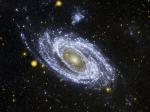 Bright Spiral Galaxy M81 in Ultraviolet from Galex
15.05.2007
Where are the hot stars in M81, one of the closest major spiral galaxies? To help find out, astronomers took a deep image in ultraviolet light of the sprawling spiral with the Earth-orbiting Galex telescope.
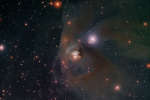 T Tauri: A Star is Formed
3.08.2009
What does a star look like when it is forming? The prototypical example is the variable star T Tauri, visible as the bright orange star near the image center. The orange star centered in this remarkable telescopic skyview is T Tauri, prototype of the class of T Tauri variable stars.
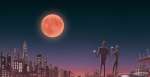 Tonight: A Supermoon Lunar Eclipse
26.09.2015
Tonight a bright full Moon will fade to red. Tonight's moon will be particularly bright because it is reaching its fully lit phase when it is relatively close to the Earth in its elliptical orbit.
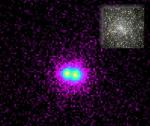 X Ray Stars in M15
20.09.2001
Side by side, two x-ray stars greeted astronomers in this false-color Chandra Observatory x-ray image of a region near the core of globular star cluster M15. The greeting was a pleasant surprise, as all previous x-ray images of the cluster showed only one such source where Chandra's sharper x-ray vision now reveals two.
 Zeta Oph: Runaway Star
29.12.2012
Like a ship plowing through cosmic seas, runaway star Zeta Ophiuchi produces the arcing interstellar bow wave or bow shock seen in this stunning infrared portrait. In the false-color view, bluish Zeta...
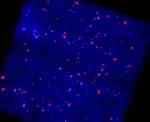 X-Rays from the Galactic Plane
14.08.2001
In February 2000, the orbiting Chandra X-ray Observatory spent 27 hours staring into the plane of our Milky Way galaxy. Its target was a spot in the small constellation Scutum, within the Milky Way's zone of avoidance where galactic gas and dust clouds block visible light, making a poor window for optical telescopes.
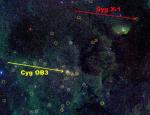 Cyg X-1: Can Black Holes Form in the Dark?
2.04.2005
The formation of a black hole from the collapsing core of a massive star is thought to be heralded by a spectacular supernova explosion. Such an extremely energetic collapse is also a leading explanation for the mysterious cosmic gamma-ray bursts.
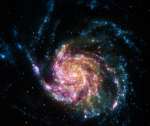 21st Century M101
13.07.2012
One of the last entries in Charles Messier's famous catalog, big, beautiful spiral galaxy M101 is definitely not one of the least. About 170,000 light-years across, this galaxy is enormous, almost twice the size of our own Milky Way Galaxy.
|
January February March April May June July August September October |
|||||||||||||||||||||||||||||||||||||||||||||||||