
|
You entered: color
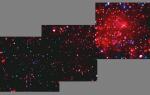 X Ray Stars and Winds in the Rosette Nebula
19.10.2001
This mosaic of x-ray images cuts a swath across the photogenic Rosette Nebula, a stellar nursery 5,000 light-years from Earth in the constellation Monoceros, the Unicorn. Constructed from data recorded by the orbiting...
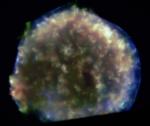 X Rays From Tycho s Supernova Remnant
22.05.2004
In 1572, Danish astronomer Tycho Brahe recorded the sudden appearance of a bright new star in the constellation Cassiopeia. The new star faded from view over a period of months and is believed to have been a supernova, one of the last stellar explosions seen in our Milky Way galaxy.
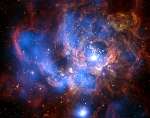 NGC 604: X rays from a Giant Stellar Nursery
5.02.2009
Some 3 million light-years distant in nearby spiral galaxy M33, giant stellar nursery NGC 604 is about 1,300 light-years across, or nearly 100 times the size of the Orion Nebula. In fact, among...
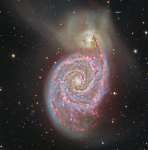 Hydrogen in M51
11.06.2010
Perhaps the original spiral nebula, M51 is a large galaxy, over 60,000 light-years across, with a readily apparent spiral structure. Also cataloged as NGC 5194, M51 is a part of a well-known interacting galaxy pair, its spiral arms and dust lanes clearly sweeping in front of companion galaxy NGC 5195 (top).
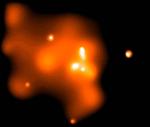 X-Rays From The Galactic Center
20.01.2000
Exploring quasars and active galaxies in the distant universe, astronomers have come to believe that most galaxies have massive black holes at their centers. Swirling stars and a strong, variable radio source offer convincing evidence that even our own Milky Way galaxy's center harbors such a bizarre object, a mere 30,000 light-years away.
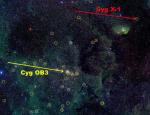 Cyg X-1: Can Black Holes Form in the Dark
12.06.2003
The formation of a black hole from the collapsing core of a massive star is thought to be heralded by a spectacular supernova explosion. Such an extremely energetic collapse is also a leading explanation for the mysterious cosmic gamma-ray bursts.
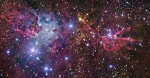 Fox Fur, a Unicorn, and a Christmas Tree
25.12.2008
Clouds of glowing hydrogen gas fill this colorful skyscape in the faint but fanciful constellation Monoceros, the Unicorn. A star forming region cataloged as NGC 2264, the complex jumble of cosmic gas and dust...
 APOD: 2024 March 18 Б Comet Pons Brooks Swirling Coma
18.03.2024
A bright comet will be visible during next month's total solar eclipse. This very unusual coincidence occurs because Comet 12P/Pons-Brooks's return to the inner Solar System places it by chance only 25 degrees away from the Sun during Earth's April 8 total solar eclipse.
 EUVE Sky Map
31.01.2002
The stars beyond the Sun and the distant galaxies should be undetectable at extreme ultraviolet wavelengths. At least that was the conventional wisdom when it was first realized that the space between the stars is filled with hydrogen, a strong absorber of extreme ultraviolet light.
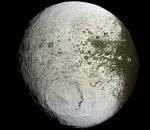 The Strange Tailing Side of Saturns Iapetus
10.10.2007
What has happened to Saturn's moon Iapetus? Vast sections of this strange world are dark as coal, while others are as bright as ice. The composition of the dark material is unknown, but infrared spectra indicate that it possibly contains some dark form of carbon.
|
January February March April May June July August September October |
|||||||||||||||||||||||||||||||||||||||||||||||||