
|
You entered: color
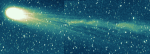 Comet Hyakutake's Past and Future
23.03.1996
The above false-color picture of Comet Hyakutake taken just two days ago shows its rapidly developing tail. The comet now has a substantial coma with a bright center, lending it a dramatic eye-like appearance. This is not Comet Hyakutake's first visit to the inner Solar System.
 Lunar Prospects
18.09.1998
Launched on January 6th, NASA's Lunar Prospector spacecraft has been exploring the Moon with instruments designed to sense global properties while orbiting pole-to-pole, 63 miles above the lunar surface. Now over half...
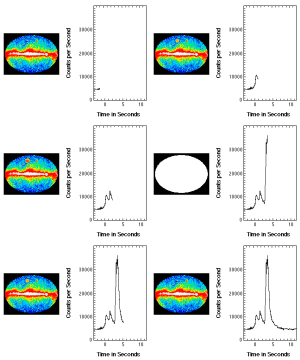 Gamma Ray Bursting
4.11.1999
Using graphics and data from NASA's Compton Gamma Ray Observatory, this animation illustrates one of the most exciting mysteries of modern astrophysics, gamma-ray bursts. Incredibly gamma-ray bursts, sudden flashes of radiation with over 100,000 times the energy of visible light photons, occur several times a day.
 La Superba
18.12.2008
Y Canum Venaticorum (Y CVn) is a very rare star in planet Earth's night sky. It's also very red, exhibiting such a remarkable spectrum of light, 19th century astronomer Angelo Secchi dubbed it La Superba.
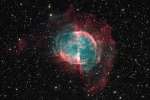 M27: Not a Comet
26.08.2010
While hunting for comets in the skies above 18th century France, astronomer Charles Messier diligently kept a list of the things he encountered that were definitely not comets. This is number 27 on his now famous not-a-comet list.
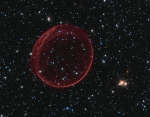 The Rippled Red Ribbons of SNR 0509
25.01.2011
What is causing the picturesque ripples of supernova remnant SNR 0509-67
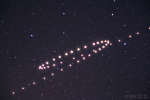 Mars in the Loop
9.08.2012
This composite of images spaced some 5 to 7 days apart from late October 2011 (top right) through early July 2012 (bottom left), traces the retrograde motion of ruddy-colored Mars through planet Earth's night sky.
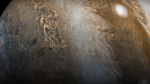 Perijove 11: Passing Jupiter
28.08.2022
Here comes Jupiter! NASA's robotic spacecraft Juno is continuing on its highly-elongated orbits around our Solar System's largest planet. The featured video is from perijove 11 in early 2018, the eleventh time Juno has passed near Jupiter since it arrived in mid-2016.
 X rays from Stephan s Quintet
12.08.2003
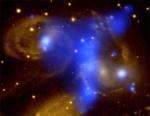
Stephan's Quintet is a picturesque but clearly troubled grouping of galaxies about 300 million light-years away toward the high-flying constellation Pegasus. Spanning over 200,000 light-years at that distance, this composite false-color image...
 Gamma Ray Moon
17.04.1999
What if you could see gamma rays (photons with more than 40 million times the energy of visible light)? If you could, the Moon would appear brighter than the Sun! This startling notion...
|
January February March April May June July August September October |
|||||||||||||||||||||||||||||||||||||||||||||||||