
|
You entered: color
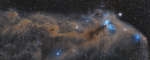 Across Corona Australis
29.11.2018
Cosmic dust clouds are draped across a rich field of stars in this broad telescopic panorama near the northern boundary of Corona Australis, the Southern Crown. Less than 500 light-years away the denser clouds effectively block light from more distant background stars in the Milky Way.
 The Hydrogen Clouds of M33
30.09.2021
Gorgeous spiral galaxy M33 seems to have more than its fair share of glowing hydrogen gas. A prominent member of the local group of galaxies, M33 is also known as the Triangulum Galaxy and lies a mere 3 million light-years away.
 APOD: 2023 August 2 Б M82: Galaxy with a Supergalactic Wind
2.08.2023
Why is the Cigar Galaxy billowing red smoke? M82, as this starburst galaxy is also known, was stirred up by a recent pass near large spiral galaxy M81. This doesn't fully explain the source of the red-glowing outwardly expanding gas and dust, however.
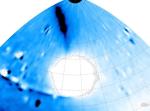 Shadow Of A Comet
2.07.1999
Hale-Bopp, the Great Comet of 1997, may have been the most viewed comet in history - visible even from bright metropolitan skies. Astronomers are now reporting that this magnificent comet also cast a shadow against the glare of the solar system's ultraviolet haze.
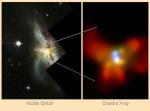 The Supermassive Black Holes of NGC 6240
28.11.2002
The Hubble optical image on the left shows NGC 6240 in the throes of a titanic galaxy - galaxy collision 400 million light-years away. As the cosmic catastrophe plays out, the merging galaxies spew forth distorted tidal tails of stars, gas, and dust and undergo frantic bursts of star formation.
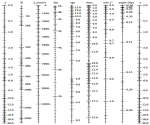 A Redshift Lookup Table for our Universe
8.04.2013
How far away is "redshift six"? Although humans are inherently familiar with distance and time, what is actually measured for astronomical objects is redshift, a color displacement that depends on exactly how energy density has evolved in our universe.
 Cartwheel Of Fortune
18.01.2006
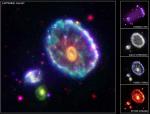
By chance, a collision of two galaxies has created a surprisingly recognizable shape on a cosmic scale - The Cartwheel Galaxy. The Cartwheel is part of a group of galaxies about 400 million light years away in the constellation Sculptor (two smaller galaxies in the group are visible below and left).
 Saturn s Ancient Rings
17.12.2007
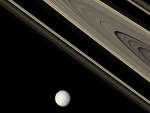
How old are Saturn's rings? No one is quite sure. One possibility is that the rings formed relatively recently in our Solar System's history, perhaps only about 100 million years ago when a moon-sized object broke up near Saturn.
 The Local Fluff
24.09.2013
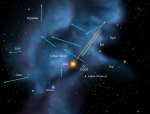
The stars are not alone. In the disk of our Milky Way Galaxy about 10 percent of visible matter is in the form of gas, called the interstellar medium (ISM). The ISM is not uniform, and shows patchiness even near our Sun.
 Double Cluster in Perseus
23.01.2014
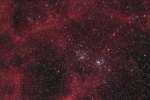
This lovely starfield spans some seven full moons (about 3.5 degrees) across the heroic northern constellation of Perseus. Just right of center it holds the famous pair of open or galactic star clusters, h and Chi Perseii.
|
January February March April May June July August September October |
|||||||||||||||||||||||||||||||||||||||||||||||||