
|
You entered: color
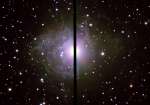 Echoes from RS Pup
12.02.2008
This dusty reflection nebula surrounds pulsating star RS Pup, some 10 times more massive than the Sun and on average 15,000 times more luminous. In fact, RS Pup is a Cepheid type variable...
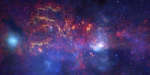 Great Observatories Explore Galactic Center
11.11.2009
Where can a telescope take you? Four hundred years ago, a telescope took Galileo to the Moon to discover craters, to Saturn to discover rings, to Jupiter to discover moons, to Venus to discover phases, and to the Sun to discover spots.
 Stars and Dust Across Corona Australis
12.09.2013
Cosmic dust clouds sprawl across a rich field of stars in this sweeping telescopic vista near the northern boundary of Corona Australis, the Southern Crown. Less than 500 light-years away the dust clouds effectively block light from more distant background stars in the Milky Way.
 The Sky from Mauna Kea
11.05.2015
What if you could stand at the top of a volcano and peer out across the universe? It the timing is right, you might see an amazing panorama like the one featured here.
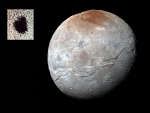 Charon: Moon of Pluto
6.07.2018
A darkened and mysterious north polar region known to some as Mordor Macula caps this premier high-resolution view. The portrait of Charon, Pluto's largest moon, was captured by New Horizons near the spacecraft's closest approach on July 14, 2015.
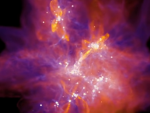 STARFORGE: A Star Formation Simulation
23.06.2021
How do stars form? Most form in giant molecular clouds located in the central disk of a galaxy. The process is started, influenced, and limited by the stellar winds, jets, high energy starlight, and supernova explosions of previously existing stars.
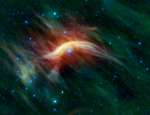 Zeta Oph: Runaway Star
4.02.2011
Like a ship plowing through cosmic seas, runaway star Zeta Ophiuchi produces the arcing interstellar bow wave or bow shock seen in this stunning infrared portrait from the WISE spacecraft. In the false-color view...
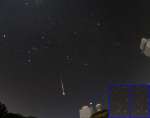 Leonid Fireball over Tenerife
22.11.2011
Historically active, this year's Leonid meteor shower was diminished by bright moonlight. Still, faithful night sky watchers did see the shower peak on November 18 and even the glare of moonlight didn't come close to masking this brilliant fireball meteor.
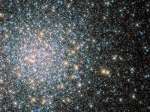 Hubble s Messier 5
25.04.2014
"Beautiful Nebula discovered between the Balance [Libra] & the Serpent [Serpens] ..." begins the description of the 5th entry in 18th century astronomer Charles Messier's famous catalog of nebulae and star clusters. Though it appeared...
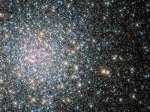 Hubble s Messier 5
20.06.2015
"Beautiful Nebula discovered between the Balance [Libra] & the Serpent [Serpens] ..." begins the description of the 5th entry in 18th century astronomer Charles Messier's famous catalog of nebulae and star clusters. Though it appeared...
|
January February March April May June July August September October |
|||||||||||||||||||||||||||||||||||||||||||||||||