
|
You entered: color
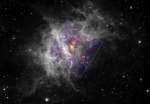 Young Star Cluster Westerlund 2
26.06.2010
Dusty stellar nursery RCW 49 surrounds young star cluster Westerlund 2 in this remarkable composite skyscape from beyond the visible spectrum of light. Infrared data from the Spitzer Space Telescope is shown in black...
 The North America Nebula in Infrared
14.02.2011
The North America Nebula can do what most North Americans cannot -- form stars. Precisely where in the nebula these stars are forming has been mostly obscured by some of the nebula's thick dust that is opaque to visible light.
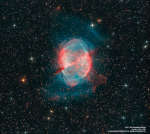 M27: Not a Comet
19.08.2015
While hunting for comets in the skies above 18th century France, astronomer Charles Messier diligently kept a list of the things he encountered that were definitely not comets. This is number 27 on his now famous not-a-comet list.
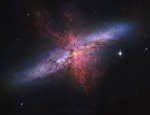 M82: Galaxy with a Supergalactic Wind
22.07.2019
Why is the Cigar Galaxy billowing red smoke? M82, as this starburst galaxy is also known, was stirred up by a recent pass near large spiral galaxy M81. This doesn't fully explain the source of the red-glowing outwardly expanding gas and dust, however.
 APOD: 2024 October 20 Б Dark Matter in a Simulated Universe
19.10.2024
Is our universe haunted? It might look that way on this dark matter map. The gravity of unseen dark matter is the leading explanation for why galaxies rotate so fast, why galaxies orbit clusters...
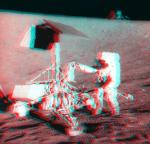 Apollo Surveyor Stereo View
9.03.2001
Put on your red/blue glasses and gaze into this dramatic stereo view from the surface of the Moon! Inspired by last Saturday's APOD, Patrick Vantuyne offers this stereo rendering of the captivating picture of Apollo 12 astronaut Pete Conrad visiting the Surveyor
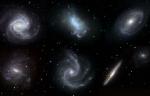 Visitors Galaxy Gallery
18.06.2005
A tantalizing assortment of island universes is assembled here. From top left to bottom right are the lovely but distant galaxies M61, NGC 4449, NGC 4725, NGC 5068, NGC 5247, and NGC 5775/5774. Most are spiral galaxies more or less like our own Milky Way.
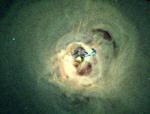 X Rays from the Perseus Cluster Core
7.12.2005
The Perseus Cluster of thousands of galaxies, 250 million light-years distant, is one of the most massive objects in the Universe and the brightest galaxy cluster in the x-ray sky. At its core lies the giant cannibal galaxy Perseus A (NGC 1275), accreting matter as gas and galaxies fall into it.
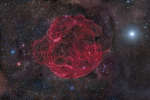 Simeis 147: Supernova Remnant
9.10.2012
It's easy to get lost following the intricate filaments in this detailed mosaic image of faint supernova remnant Simeis 147 (S147). Also cataloged as Sh2-240, it covers nearly 3 degrees or 6 full moons on the sky. That's about 150 light-years at the stellar debris cloud's estimated distance of 3,000 light-years.
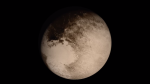 Flying Past Pluto
5.10.2015
What would it look like to fly past Pluto? The robotic New Horizons spacecraft did just this in late July and continues to return stunning pictures of the dwarf planet. Some well-chosen flyby images have now been digitally sequenced to create the featured video.
|
January February March April May June July August September October |
|||||||||||||||||||||||||||||||||||||||||||||||||