
|
You entered: Earth
 Radio, The Big Ear, and the WOW Signal
2.05.2020
Since the early days of radio and television we have been freely broadcasting signals into space. For some time now, we have been listening too. A large radio telescope at Ohio State University known as affectionately The Big Ear was one of the first listeners.
 Early Microscopic Life on Mars?
7.08.1996
Today a team of NASA and Stanford scientists announced the discovery of strong circumstantial evidence that microscopic life once existed on Mars. Dr. David McKay, Dr. Everett Gibson, and Kathie Thomas-Keprta of Lockheed-Martin, all from (NASA /JSC), and Dr.
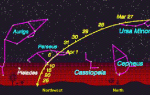 Comet Hyakutake Finder Chart for Early April
31.03.1996
During April Comet Hyakutake heads in toward the Sun after passing the Earth. At this time the comet's orbit places it north of the Earth. Remaining visible in the northern sky as it nears the Sun, it will set progressively earlier in the evening.
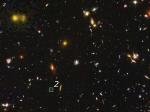 Building Galaxies in the Early Universe
10.09.2007
What was the very early universe like? To help find out, astronomers pointed the Hubble Space Telescope between bright nearby objects to create one of the deepest images ever -- the Hubble Ultra Deep Field (HUDF). The resulting HUDF is like a jewel box of strange and distant galaxies.
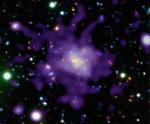 Galaxy Cluster in the Early Universe
26.02.2004
Long before medieval alchemists dreamed of transmuting base metals to gold, stellar furnaces in this massive cluster of galaxies - cataloged as RDCS 1252.9-2927 - had transformed light elements into heavy ones. In the false-color composite image individual cluster galaxies can be seen at optical and near-infrared wavelengths, shown in red, yellow, and green colors.
 Radio, The Big Ear, And The Wow! Signal
17.09.1998
Since the early days of radio and television we have been freely broadcasting signals into space. For some time now, we have been listening too. Ohio State University's radio telescope, affectionately known as "The Big Ear" , was one of the first and largest listeners.
 Earendel: A Star in the Early Universe
6.04.2022
Is Earendel the farthest star yet discovered? This scientific possibility started when the Hubble Space Telescope observed a huge cluster of galaxies. The gravitational lens effectбof this cluster was seen to magnify and distort a galaxy far in the background.
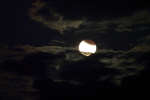 A Partial Lunar Eclipse
28.06.2010
What's happened to the Moon? This past weekend, once again, part of the Moon moved through the Earth's shadow. This happens about once or twice a year, on the average, but not each month since the Moon's orbit around the Earth is slightly tilted.
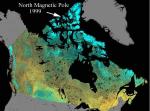 Earths North Magnetic Pole
18.08.2002
A magnetic compass does not point toward the true North Pole of the Earth. Rather, it more closely points toward the North Magnetic Pole of the Earth. The North Magnetic Pole is currently located in northern Canada.
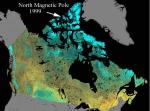 Earths North Magnetic Pole
19.09.2004
A magnetic compass does not point toward the true North Pole of the Earth. Rather, it more closely points toward the North Magnetic Pole of the Earth. The North Magnetic Pole is currently located in northern Canada.
|
January February March April May June July August September October |
|||||||||||||||||||||||||||||||||||||||||||||||||