
|
You entered: Earth
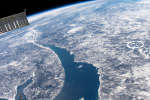 APOD: 2025 October 11 Б Manicouagan Impact Crater from Space
11.10.2025
Orbiting 400 kilometers above Quebec, Canada, planet Earth, the International Space Station Expedition 59 crew captured this snapshot of the broad St. Lawrence River and curiously circular Lake Manicouagan on April 11, 2019. Right of center, the ring-shaped lake is a modern reservoir within the eroded remnant of an ancient 100 kilometer diameter impact crater.
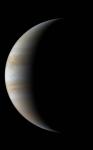 Farewell Jupiter
8.08.2001
Next stop: Saturn. The Cassini spacecraft, launched from Earth four years ago, has now swung past Jupiter and should arrive at Saturn in the year 2004. Pictured to the left is a parting shot from Cassini in January that would not have been possible from Earth: Jupiter showing a crescent phase.
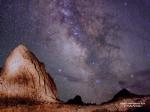 The Milky Way over Utah
1.08.2006
If sometimes it appears that the entire Milky Way Galaxy is raining down on your head, do not despair. It happens twice a day. As the Sun rises in the East, wonders of the night sky become less bright than the sunlight scattered by our own Earth's atmosphere, and so fade from view.
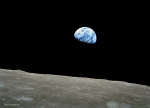 Earthrise
6.09.2015
What's that rising over the edge of the Moon? Earth. About 47 years ago, in December of 1968, the Apollo 8 crew flew from the Earth to the Moon and back again. Frank...
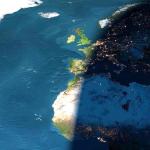 A Digital Sunset Over Europe and Africa
24.03.2003
No single spacecraft or astronaut took this picture. It is a digital composite of archived images taken over many orbits by several Earth-orbiting satellites. Similar images can be digitally stitched together for any Earth location by John Walker's Earth and Moon Viewer website.
 APOD: 2024 October 8 Б Annular Eclipse over Patagonia
8.10.2024
Can you find the Sun? OK, but can you explain why thereБs a big dark spot in the center? The spot is the Moon, and the impressive alignment shown, where the Moon lines up inside the Sun, is called an annular solar eclipse.
 Saturn at Night
24.10.2025
Saturn is bright in Earth's night skies. Telescopic views of the outer gas giant planet and its beautiful rings often make it a star at star parties. But this stunning view of Saturn's rings and night side just isn't possible from telescopes in the vicinity of planet Earth.
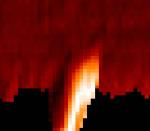 Tornadoes on the Sun
29.04.1998
Giant spinning clouds of gas, similar to Earth's tornadoes, have been found on the Sun. Solar tornadoes, however, can be larger than the entire Earth, and sustain wind gusts over 1000 times stronger than their Earth counterparts.
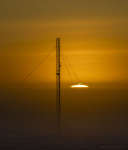 Sunrise at the South Pole
5.10.2021
Sunrise at the South Pole is different. Usually a welcome sight, it follows months of darkness -- and begins months of sunshine. At Earth's poles, it can take weeks for the Sun to rise, in contrast with just minutes at any mid-latitude location.
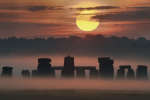 Sunrise Solstice at Stonehenge
21.06.2010
Today the Sun reaches its northernmost point in planet Earth's sky. Called a solstice, the date traditionally marks a change of seasons -- from spring to summer in Earth's Northern Hemisphere and from fall to winter in Earth's Southern Hemisphere.
|
January February March April May June July August September October |
|||||||||||||||||||||||||||||||||||||||||||||||||