
|
You entered: apod
 APOD: 2024 February 11 Б Rocket Plume Shadow Points to the Moon
10.02.2024
Why would the shadow of a rocket's launch plume point toward the Moon? In early 2001 during a launch of the space shuttle Atlantis, the Sun, Earth, Moon, and rocket were all properly aligned for this photogenic coincidence.
 APOD: 2023 May 29 Б Milky Way over a Turquoise Wonderland
28.05.2023
What glows there? The answer depends: sea or sky? In the sea, the unusual blue glow is bioluminescence. Specifically, the glimmer arises from Noctiluca scintillans, single-celled plankton stimulated by the lapping waves. The plankton use their glow to startle and illuminate predators.
 APOD: 2024 February 14 Б Rosette Deep Field
13.02.2024
Can you find the Rosette Nebula? The large, red, and flowery-looking nebula on the upper left may seem the obvious choice, but that is actually just diffuse hydrogen emission surrounding the Cone and Fox Fur Nebulas.
 APOD: 2025 August 5 Б NGC 6072: A Complex Planetary Nebula from Webb
4.08.2025
Why is this nebula so complex? The Webb Space Telescope has imaged a nebula in great detail that is thought to have emerged from a Sun-like star. NGC 6072 has been resolved into one of the more unusual and complex examples of planetary nebula.
 APOD: 2025 September 20 Б Gibbous vs Crescent
19.09.2025
Early risers around planet Earth have enjoyed a shining crescent Moon near brilliant Venus, close to the eastern horizon in recent morning twilight skies. And yesterday, on September 19, skygazers watching from some locations...
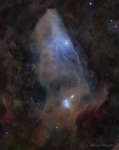 APOD: 2026 April 7 Б IC 4592: The Blue Horsehead Reflection Nebula
6.04.2026
Do you see the horse's head? What you are seeing is not the famous Horsehead nebula toward Orion, but rather a fainter nebula that only takes on a familiar form with deeper imaging. The main part of the here-imaged molecular cloud complex is reflection nebula IC 4592.
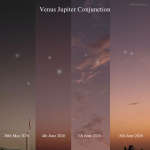 APOD: 2026 June 14 Б 10 Days of Venus and Jupiter
13.06.2026
Venus and Jupiter may have caught your attention lately. The recent close conjunction of the two brightest planets in recent evening skies has been hard to miss. With Jupiter at the top, starting...
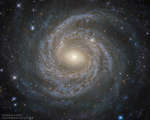 APOD: 2020 August 16 Б NGC 6814: Grand Design Spiral Galaxy from Hubble
15.08.2020
In the center of this serene stellar swirl is likely a harrowing black-hole beast. The surrounding swirl sweeps around billions of stars which are highlighted by the brightest and bluest. The breadth and beauty of the display give the swirl the designation of a grand design spiral galaxy.
 APOD: 2025 May 12 Б Gaia Reconstructs a Side View of our Galaxy
11.05.2025
What does our Milky Way Galaxy look like from the side? Because we are on the inside, humanity canБt get an actual picture. Recently, however, just such a map has been made using location data for over a billion stars from ESAБs Gaia mission.
 APOD: 2023 August 21 Б Introducing Comet Nishimura
20.08.2023
Will Comet Nishimura become visible to the unaided eye? Given the unpredictability of comets, no one can say for sure, but it currently seems like a good bet. The comet was discovered only ten days ago by Hideo Nishimura during 30-second exposures with a standard digital camera.
|
January February March April May June July August September |
|||||||||||||||||||||||||||||||||||||||||||||||||