
|
You entered: apod
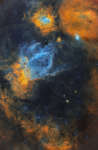 APOD: 2026 April 01 Б The Claw and Bubble Nebulae
1.04.2026
What unexpected things do you see when you look up at the night sky? TodayБs image resembles an abstract painting, with large swaths of color strewn across a cosmic canvas seemingly without design. Despite the image's abstract nature, the human mind finds patterns, identifying a large claw reaching up towards a floating bubble.
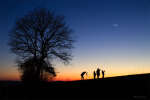 APOD: 2023 March 15 Б Jupiter and Venus Converge over Germany
15.03.2023
This was a sky to show the kids. Early this month the two brightest planets in the night sky, Jupiter and Venus, appeared to converge. At their closest, the two planets were separated by only about the angular width of the full moon.
 APOD: 2024 May 29 Б Stairway to the Milky Way
29.05.2024
What happens if you ascend this stairway to the Milky Way? Before answering that, let's understand the beautiful sky you will see. Most eye-catching is the grand arch of the Milky Way Galaxy...
 APOD: 2025 April 15 Б Planetary Nebula NGC 1514 from Webb
15.04.2025
What happens when a star runs out of nuclear fuel? For stars like our Sun, the center condenses into a white dwarf while the outer atmosphere is expelled into space to appear as a planetary nebula.
 APOD: 2006 October 1- Earth at Night
1.10.2006
This is what the Earth looks like at night. Can you find your favorite country or city? Surprisingly, city lights make this task quite possible. Human-made lights highlight particularly developed or populated areas of the Earth's surface, including the seaboards of Europe, the eastern United States, and Japan.
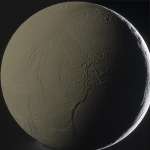 APOD: 2023 February 5 Б Enceladus by Saturnshine
5.02.2023
This moon is shining by the light of its planet. Specifically, a large portion of Enceladus pictured here is illuminated primarily by sunlight first reflected from the planet Saturn. The result is that the normally snow-white moon appears in the gold color of Saturn's cloud tops.
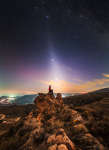 APOD: 2023 February 27 Б Zodiacal Ray with Venus and Jupiter
27.02.2023
What's causing that unusual ray of light extending from the horizon? Dust orbiting the Sun. At certain times of the year, a band of sun-reflecting dust from the inner Solar System appears prominently after sunset or before sunrise and is called zodiacal light.
 APOD: 2023 April 26 Б The Moon through the Arc de Triomphe
26.04.2023
Was this a lucky shot? Although many amazing photographs are taken by someone who just happenedбto be in the right place at the right time, this image took skill and careful planning. First...
 APOD: 2023 May 9 Б Shadows of Earth
9.05.2023
Can you find two Earth shadows in today's image? It's a bit tricky. To find the first shadow, observe that the top part of the atmosphere appears pink and the lower part appears blue. This is because the top half is exposed to direct sunlight, while the lower part is not.
 APOD: 2025 June 28 Б Lunar Farside
28.06.2025
Tidally locked in synchronous rotation, the Moon always presents its familiar nearside to denizens of planet Earth. From lunar orbit, the Moon's farside can become familiar, though. In fact this sharp picture, a mosaic from the Lunar Reconnaissance Orbiter's wide angle camera, is centered on the lunar farside.
|
January February March April May June July August |
||||||||||||||||||||||||||||||||||||||||||||||||||||||||