
|
You entered: asteroid
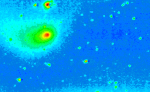 Comet Hale-Bopp Outbound
10.09.1997
Hale-Bopp, the Comet of the Century, is leaving the inner Solar System. Outbound at about 12 miles per second it is presently nearing the main asteroid belt between Mars and Jupiter. This false-color image represents a recent view from low Earth orbit showing the comet surrounded by its shrinking coma against a background of stars.
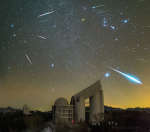 Geminid Meteors over Xinglong Observatory
23.12.2015
Where do Geminid meteors come from? In terms of location on the sky, as the featured image composite beautifully demonstrates, the sand-sized bits of rock that create the streaks of the Geminid Meteor Shower appear to flow out from the constellation of Gemini.
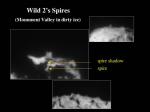 Unusual Spires Found on Comet Wild 2
22.06.2004
How did unusual spires form on comet Wild 2? Close inspection of images taken of Comet Wild 2 by the passing Stardust spacecraft in January show numerous strange pinnacles as long as 100 meters long jutting off the surface. The pinnacles were unexpected - close-ups of other comets and asteroids show no such features.
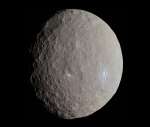 Dwarf Planet Ceres
4.02.2016
Dwarf planet Ceres is the largest object in the Solar System's main asteroid belt, with a diameter of about 950 kilometers (590 miles). Ceres is seen here in approximately true color, based on image data from the Dawn spacecraft recorded on May 4, 2015.
 APOD: 2024 September 16 Б Mercurys Vivaldi Crater from BepiColombo
16.09.2024
Why does this large crater on Mercury have two rings and a smooth floor? No one is sure. The unusual feature called Vivaldi Crater spans 215 kilometers and was imaged again in great detail by ESA's and JAXA's robotic BepiColombo spacecraft on a flyby earlier this month.
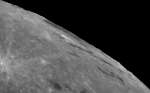 APOD: 2026 July 10 Б Western Moon, Eastern Sea
10.07.2026
The Mare Orientale, Latin for Eastern Sea, is one of the most striking large scale lunar features. The youngest of the large lunar impact basins it's very difficult to see from an earthbound perspective.
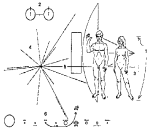 Greetings from the Pioneers
30.06.1996
Launched in the early 1970s Pioneer 10 and 11 were appropriately named - becoming the first spacecraft to travel through the asteroid belt, first to fly by Jupiter and Saturn, and the first human artifacts to venture beyond the solar system.
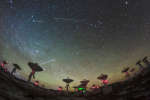 Quadrantids of the North
8.01.2022
Named for a forgotten constellation, the Quadrantid Meteor Shower puts on an annual show for planet Earth's northern hemisphere skygazers. The shower's radiant on the sky lies within the old, astronomically obsolete constellation Quadrans Muralis.
 APOD: 2023 July 24 Б Chemicals Glow as a Meteor Disintegrates
24.07.2023
Meteors can be colorful. While the human eye usually cannot discern many colors, cameras often can. Pictured here is a fireball, a disintegrating meteor that was not only one of the brightest the photographer has ever seen, but colorful.
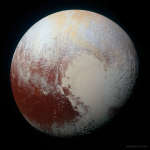 APOD: 2026 September 6 Б Pluto in Enhanced Color
6.09.2026
Pluto is more colorful than we can see. Color data and high-resolution images of our Solar System's most famous dwarf planet, taken by the robotic New Horizons spacecraft during its flyby in 2015 July, have been digitally combined to give an enhanced-color view of this ancient world sporting an unexpectedly young surface.
|
January February March April May June July August September |
|||||||||||||||||||||||||||||||||||||||||||||||||