
|
You entered: asteroid
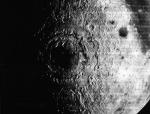 Mare Orientale
22.11.2002
Like a target ring bull's-eye, the Mare Orientale is one of the most striking large scale lunar features. Located on the Moon's extreme western edge, this impact basin is unfortunately difficult to see from an earthbound perspective.
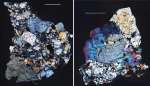 Vesta Rocks
10.12.2011
These colorful images are of thin slices of meteorites viewed through a polarizing microscope. Part of the group classified as HED meteorites for their mineral content (Howardite, Eucrite, Diogenite), they likely fell to Earth from 4 Vesta, the mainbelt asteroid currently being explored by NASA's Dawn spacecraft.
 APOD: 2024 November 27 Б The Meteor and the Comet
26.11.2024
How different are these two streaks? The streak on the upper right is Comet Tsuchinshan-Atlas showing an impressive dust tail. The comet is a large and dirty iceberg that entered the inner Solar System and is shedding gas and dust as it is warmed by the Sun's light.
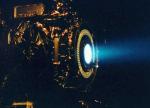 An Ion Drive for Deep Space 1
25.10.1998
Space travel entered the age of the ion drive Saturday with the launch of Deep Space 1, a NASA mission designed primarily to test new technologies. Deep Space 1 is bound for asteroid 1992 KD in July 1999.
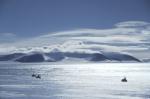 Searching for Meteorites in Antarctica
25.12.2002
Where is the best place on Earth to find meteorites? Although meteors fall all over the world, they usually just sink to the bottom of an ocean, are buried by shifting terrain, or are easily confused with terrestrial rocks.
 Eugene Shoemaker: 1928-1997
14.01.1998
Eugene Shoemaker's passion was Astrogeology. He dreamed of going to the Moon. Credited with inventing the branch of Astrogeology within the U.S. Geological Survey, his contributions to the field and the study of impact craters, lunar science, asteroids, and comets are legendary.
 Phobos Over Mars
28.11.2003
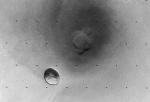
Hurtling through space a mere 3,000 miles above the Martian surface, the diminutive moon Phobos (below and left of center) was imaged against the backdrop of a large shield volcano by the Viking 2 Orbiter in 1977.
 Hubble View: Jupiter Impact
31.07.2009
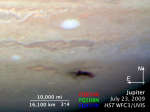
This sprawling dark marking is Jupiter's latest impact scar, a debris plume created as a small asteroid or comet disintegrated after plunging into the gas giant's atmosphere. Located in Jupiter's south polar region, the new feature was discovered by Australian amateur astronomer Anthony Wesley on July 19.
 A Colorful Quadrantid Meteor
1.02.2021
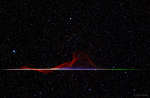
Meteors can be colorful. While the human eye usually cannot discern many colors, cameras often can. Pictured is a Quadrantids meteor captured by camera over Missouri, USA, early this month that was not only impressively bright, but colorful. The radiant grit, likely cast off by asteroid 2003 EH1, blazed a path across Earth's atmosphere.
 A Rainbow Geminid Meteor
18.12.2018
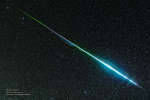
Meteors can be colorful. While the human eye usually cannot discern many colors, cameras often can. Pictured is a Geminid captured by camera during last week's meteor shower that was not only impressively bright, but colorful.
|
January February March April May June July August September |
|||||||||||||||||||||||||||||||||||||||||||||||||