
|
You entered: asteroid
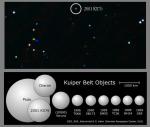 How Big Is 2001 KX76
30.08.2001
Newly discovered minor planet 2001 KX76 is circled in the top panel above, a recent composite image from the European Southern Observatory's 2.2 meter telescope at La Silla, Chile. Though 2001 KX76 appears...
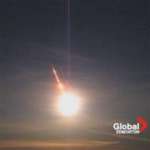 Fireball Over Edmonton
24.11.2008
What if you're driving down the street and an object from space shoots across the sky right in front of you? Such was the case last week for many people in south central Canada.
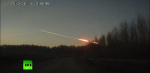 The Great Russian Meteor of 2013
18.02.2013
What in heaven's blazes is that? Thousands of people living near the Ural Mountains in Russia saw last Friday morning one of the more spectacular meteors of modern times streak across the sky. Forceful sound waves arrived at the ground minutes later, knocking people over and breaking windows for hundreds of kilometers.
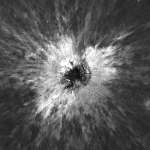 APOD: 2026 September 23 Б A New Lunar Crater: McGetchin
22.09.2026
A once-in-a-lifetime crater has appeared on the Moon! A comet or asteroid roughly the size of a humpback whale (approximately 10-20 meters, 30-60 feet) crashed into the Moon sometime between April and May of 2024.
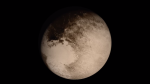 Flying Past Pluto
5.10.2015
What would it look like to fly past Pluto? The robotic New Horizons spacecraft did just this in late July and continues to return stunning pictures of the dwarf planet. Some well-chosen flyby images have now been digitally sequenced to create the featured video.
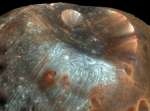 Stickney Crater
6.11.2009
Stickney Crater, the largest crater on the martian moon Phobos, is named for Chloe Angeline Stickney Hall, mathematician and wife of astronomer Asaph Hall. Asaph Hall discovered both the Red Planet's moons in 1877.
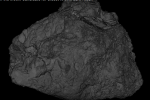 Found on the Moon: Candidate for Oldest Known Earth Rock
2.02.2021
Was the oldest known rock on Earth found on the Moon? Quite possibly. The story opens with the Apollo 14 lunar mission. Lunar sample 14321, a large rock found in Cone crater by astronaut...
 APOD: 2025 June 4 Б A Milky Road to the Rubin Observatory
3.06.2025
Is the sky the same every night? No -- the night sky changes every night in many ways. To better explore how the night sky changes, the USA's NSF and DOE commissioned the Vera C. Rubin Observatory in Cerro PachцЁn, Chile.
 Early Microscopic Life on Mars?
7.08.1996
Today a team of NASA and Stanford scientists announced the discovery of strong circumstantial evidence that microscopic life once existed on Mars. Dr. David McKay, Dr. Everett Gibson, and Kathie Thomas-Keprta of Lockheed-Martin, all from (NASA /JSC), and Dr.
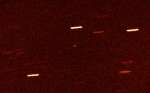 A 2017 U1: An Interstellar Visitor
2.11.2017
Traveling at high velocity along an extreme hyperbolic orbit and making a hairpin turn as it swung past the Sun, the now designated A/2017 U1 is the first known small body from interstellar space.
|
January February March April May June July August September |
|||||||||||||||||||||||||||||||||||||||||||||||||