
|
You entered: astronomy
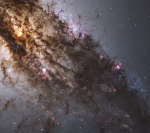 Across the Center of Centaurus A
29.11.2011
A fantastic jumble of young blue star clusters, gigantic glowing gas clouds, and imposing dark dust lanes surrounds the central region of the active galaxy Centaurus A. This image from the Hubble Space Telescope has been processed to present a natural color picture of this cosmic maelstrom.
 APOD: 2025 March 2 Б The Hubble Ultra Deep Field in Light and Sound
2.03.2025
Have you heard about the Hubble Ultra-Deep Field? Either way, you've likely not heard about it like this -- please run your cursor over the featured image and listen! The Hubble Ultra-Deep Field (HUDF)...
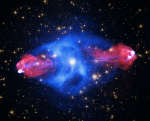 Light from Cygnus A
23.01.2015
Celebrating astronomy in this International Year of Light, the detailed image reveals spectacular active galaxy Cygnus A in light across the electromagnetic spectrum. Incorporating X-ray data ( blue) from the orbiting Chandra Observatory, Cygnus A is seen to be a prodigious source of high energy x-rays.
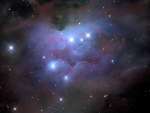 Reflections on the 1970s
20.12.2007
The 1970s are sometimes ignored by astronomers. In particular, this beautiful grouping of reflection nebulae in Orion - NGC 1977, NGC 1975, and NGC 1973 - are usually overlooked in favor of the substantial glow from the nearby stellar nursery better known as the Orion Nebula.
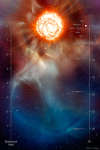 Betelgeuse Imagined
1.01.2020
Why is Betelgeuse fading? No one knows. Betelgeuse, one of the brightest and most recognized stars in the night sky, is only half as bright as it used to be only five months ago.
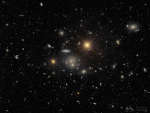 The Hydra Cluster of Galaxies
16.02.2023
Once upon a midnight dreary, while I pondered weak and weary, O'er volumes of astronomy and forgotten lore, I stumbled upon this snapshot, cosmic and eerie, A sight that filled my heart with awe and more.
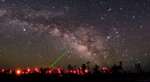 Messier Marathon
27.05.2011
In this action scene, red night vision lights, green laser pointers, tripods and telescopes in faint silhouette surround intrepid sky gazers embarked on the 10th annual Iran Messier Marathon. Completing the marathon requires viewing all 110 objects in 18th century French astronomer Charles Messier's catalog in one glorious dusk-to-dawn observing run.
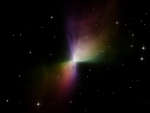 A Beautiful Boomerang Nebula
28.12.2007
This symmetric cloud dubbed the Boomerang Nebula was created by a high-speed wind of gas and dust blowing from an aging central star at speeds of nearly 600,000 kilometers per hour. The rapid...
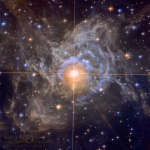 RS Puppis
17.05.2019
Pulsating RS Puppis, the brightest star in the image center, is some ten times more massive than our Sun and on average 15,000 times more luminous. In fact, RS Pup is a Cepheid...
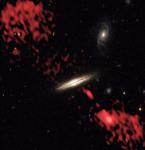 192: The Wrong Galaxy
14.01.2003
Centered above is distant galaxy 0313-192, some one billion light-years away. Radio emission from the galaxy has been mapped by the National Radio Astronomy Observatory's Very Large Array and is shown in red, composited with a visible light image from the Hubble Space Telescope's new Advanced Camera for Surveys.
|
January February March April May June July August |
||||||||||||||||||||||||||||||||||||||||||||||||||||||||