
|
You entered: astronomy
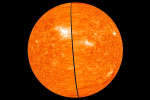 Sun 360: STEREO Captures Views of the Entire Sun
7.02.2011
For the first time, the entire Sun is being imaged all at once. This has become possible because the two STEREO satellites orbiting and monitoring the Sun are now on opposite sides of the Sun.
 Echoes from RS Pup
12.02.2008
This dusty reflection nebula surrounds pulsating star RS Pup, some 10 times more massive than the Sun and on average 15,000 times more luminous. In fact, RS Pup is a Cepheid type variable...
 Great Observatories Explore Galactic Center
11.11.2009
Where can a telescope take you? Four hundred years ago, a telescope took Galileo to the Moon to discover craters, to Saturn to discover rings, to Jupiter to discover moons, to Venus to discover phases, and to the Sun to discover spots.
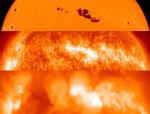 Sunspot Stack
19.04.2001
Welcome to multiwavelength astronomy! From top to bottom, these stacked panels show the largest sunspot group in a decade in visible, extreme ultraviolet, and x-ray light. All were taken on March 29, around...
 The Nebula And The Neutron Star
1.02.2003
The lonely RX J1856.5-3754 was formed from the collapsed core of an exploding star. At a distance of 180 light-years it is the closest known neutron star. More massive than...
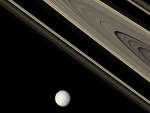 Saturn s Ancient Rings
17.12.2007
How old are Saturn's rings? No one is quite sure. One possibility is that the rings formed relatively recently in our Solar System's history, perhaps only about 100 million years ago when a moon-sized object broke up near Saturn.
 Quadrantid Meteors and Aurora from the Air
7.01.2008
Where do meteor showers originate? To help answer this question, astronomers studied in some detail the Quadrantid meteor shower that occurred over this past weekend. In particular, astronomers with specialized cameras flew as part...
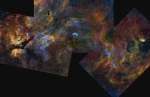 Cygnus Trio
7.11.2008
In this colorful mosaic, filaments of gas and dust span some 9 degrees across central Cygnus, a nebula rich constellation along the northern Milky Way. A trio of nebulae with popular names highlights the beautiful skyscape - the Butterfly, the Crescent, and the Tulip.
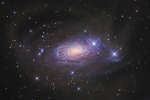 Star Streams and the Sunflower Galaxy
11.09.2010
A bright spiral galaxy of the northern sky, Messier 63 is about 25 million light-years distant in the loyal constellation Canes Venatici. Also cataloged as NGC 5055, the majestic island universe is nearly 100,000 light-years across, about the size of our own Milky Way.
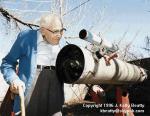 Clyde W. Tombaugh: 1906-1997
4.02.1997
Astronomer Clyde Tombaugh, discoverer of Pluto, died on January 17th. Inspiring many during his long and exceptional career, he had been living in Las Cruces, New Mexico with his wife of 60 years, Patsy. Today would have been his 91st birthday.
|
January February March April May June July August |
||||||||||||||||||||||||||||||||||||||||||||||||||||||||