
|
You entered: face
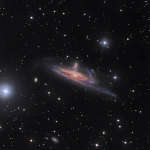 Galaxies in the River
8.01.2020
Large galaxies grow by eating small ones. Even our own galaxy engages in a sort of galactic cannibalism, absorbing small galaxies that are too close and are captured by the Milky Way's gravity.
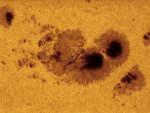 AR1520: Islands in the Photosphere
14.07.2012
Awash in a sea of plasma and anchored in magnetic fields, sunspots are planet-sized, dark islands in the solar photosphere, the bright surface of the Sun. Dark because they are slightly cooler than the surrounding surface, this group of sunspots is captured in a close-up telescopic snapshot from July 11.
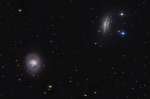 Cetus Duo M77 and NGC 1055
25.12.2014
At the top right, large spiral galaxy NGC 1055 joins spiral Messier 77 in this sharp cosmic view toward the aquatic constellation Cetus. The narrowed, dusty appearance of edge-on spiral NGC 1055 contrasts nicely with the face-on view of M77's bright nucleus and spiral arms.
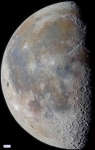 Craters and Shadows at the Lunar Terminator
22.05.2018
Why does the right part of this image of the Moon stand out? Shadows. The terminator line -- the line between light and dark -- occurs in the featured image so that just over half the Moon's face is illuminated by sunlight.
 Grand Spiral NGC 5643
26.12.2024
Viewed face-on, grand spiral galaxy NGC 5643 has a festive appearance in this colorful cosmic portrait. Some 55 million light-years distant, the galaxy extends for over 100,000 light-years, seen within the boundaries of the southern constellation Lupus.
 Europa Rotating
16.01.2001
Evidence has been mounting that beneath the vast planes of ice that cover Europa lies water -- liquid oceans that might be home to alien life. The smallest of Jupiter's Galilean Moons (which include Io, Ganymede, and Callisto), Europa's deep interior is composed of mostly of silicate rock.
 Contemplating Mars
2.09.2003
Is that really another world? Thousands of people the world over lined up last week to see Mars through a telescope as the red planet and Earth passed unusually close together in their orbits around the Sun. Reviews of Mars were mixed, with some people disappointed that Mars still appeared somewhat blurry.
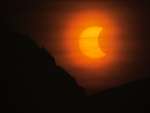 Solar Eclipse over Antarctica
2.12.2011
Last Friday, the fourth and final partial solar eclipse of 2011 was only visible from high latitudes in the southern hemisphere. If you missed it, check out this dramatic picture of the geocentric celestial event from a very high southern latitude on the continent of Antarctica.
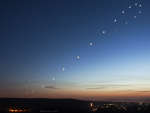 Analemma of the Moon
7.05.2020
An analemma is that figure-8 curve you get when you mark the position of the Sun at the same time each day for one year. But the trick to imaging an analemma of the Moon is to wait bit longer.
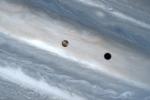 Io Shadow
23.04.1999
Orbiting Jupiter once every 43 hours, the volcanic moon Io cruises 500,000 kilometers above swirling, banded cloud-tops. Orbiting Earth once every 1.5 hours, the Hubble Space Telescope watched as Io accompanied by its shadow crossed the face of the reigning gas giant planet in 1997.
|
January February March April May June July August September |
|||||||||||||||||||||||||||||||||||||||||||||||||