
|
You entered: color
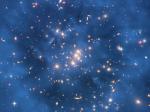 Dark Matter Ring Modeled around Galaxy Cluster CL0024 17
16.05.2007
How do we know that dark matter isn't just normal matter exhibiting strange gravity? A new observation of gravitationally magnified faint galaxies far in the distance behind a massive cluster of galaxies is shedding new dark on the subject.
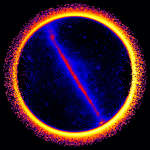 Gamma Ray Earth and Sky
6.12.2013
For an Earth-orbiting gamma-ray telescope, Earth is actually the brightest source of gamma-rays, the most energetic form of light. Gamma-rays from Earth are produced when high energy particles, cosmic rays from space, crash into the atmosphere.
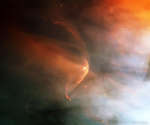 LL Orionis: When Cosmic Winds Collide
22.05.2016
What created this great arc in space? This arcing, graceful structure is actually a bow shock about half a light-year across, created as the wind from young star LL Orionis collides with the Orion Nebula flow.
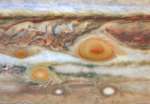 Jupiter s Three Red Spots
23.05.2008
For about 300 years Jupiter's banded atmosphere has shown a remarkable feature to telescopic viewers, a large swirling storm system known as The Great Red Spot. In 2006, another red storm system appeared, actually seen to form as smaller whitish oval-shaped storms merged and then developed the curious reddish hue.
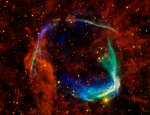 RCW 86: Historical Supernova Remnant
10.11.2011
In 185 AD, Chinese astronomers recorded the appearance of a new star in the Nanmen asterism - a part of the sky identified with Alpha and Beta Centauri on modern star charts. The new star was visible for months and is thought to be the earliest recorded supernova.
 Neutrinos in the Sun
5.06.1998
Neutrinos, along with things like electrons and quarks, are fundamental pieces of matter according to physicists' Standard Model. But neutrinos are hard to detect. Readily produced in nuclear reactions and particle collisions, they can easily pass completely through planet Earth without once interacting with any other particle.
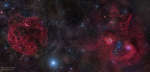 Downtown Auriga
13.02.2014
Rich in star clusters and nebulae, the ancient constellation of Auriga, the Charioteer, rides high in northern winter night skies. Spanning nearly 24 full moons (12 degrees) on the sky, this deep telescopic mosaic view recorded in January shows off some of Auriga's most popular sights for cosmic tourists.
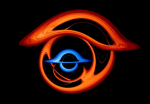 The Doubly Warped World of Binary Black Holes
16.04.2021
Light rays from accretion disks around a pair of orbiting supermassive black holes make their way through the warped space-time produced by extreme gravity in this stunning computer visualization. The simulated accretion disks have...
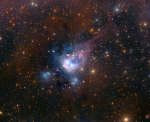 Young Suns of NGC 7129
29.08.2016
Young suns still lie within dusty NGC 7129, some 3,000 light-years away toward the royal constellation Cepheus. While these stars are at a relatively tender age, only a few million years old, it is likely that our own Sun formed in a similar stellar nursery some five billion years ago.
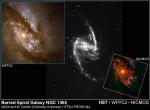 NGC 1365: Barred Spiral Galaxy
8.10.1999
NGC 1365 is a giant barred spiral galaxy about 200,000 light-years in diameter and 60 million light-years distant in the southern constellation Fornax. These three recently released images offer views of this majestic island universe in visible and infrared light.
|
January February March April May June July August September October |
|||||||||||||||||||||||||||||||||||||||||||||||||