
|
You entered: Sun
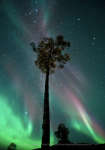 September Aurora
21.09.2012
September's equinox arrives tomorrow as the Sun crosses the celestial equator heading south. The event marks the astronomical beginning of spring in the southern hemisphere and autumn in the north. And though the connection is still puzzling, the equinox seasons bring an increase in geomagnetic storms.
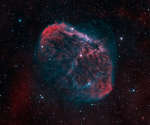 NGC 6888: The Crescent Nebula
9.06.2016
NGC 6888, also known as the Crescent Nebula, is a cosmic bubble about 25 light-years across, blown by winds from its central, bright, massive star. This sharp telescopic portrait uses narrow band image data that isolates light from hydrogen and oxygen atoms in the wind-blown nebula.
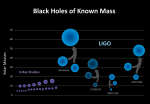 Black Holes of Known Mass
1.06.2017
Add GW170104 to the chart of black holes with known mass. The extremely energetic merger of two smaller black holes corresponds to the Laser Interferometer Gravitational-wave Observatory's (LIGO) third detection of gravitational waves.
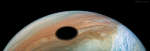 Io Eclipse Shadow on Jupiter from Juno
6.10.2019
What's that dark spot on Jupiter? It's the shadow of Jupiter's most volcanic moon Io. Since Jupiter shines predominantly by reflected sunlight, anything that blocks that light leaves a shadow. If you could somehow be in that shadow, you would see a total eclipse of the Sun by Io.
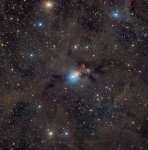 Stardust in the Perseus Molecular Cloud
17.03.2021
Clouds of stardust drift through this deep skyscape, across the Perseus molecular cloud some 850 light-years away. Dusty nebulae reflecting light from embedded young stars stand out in the nearly 2 degree wide telescopic field of view.
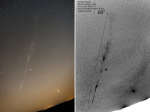 The Further Tail of Comet Leonard
29.12.2021
Comet Leonard, brightest comet of 2021, is at the lower left of these two panels captured on December 29 in dark Atacama desert skies. Heading for its perihelion on January 3 Comet Leonard's visible tail has grown.
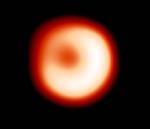 LkHa101: The Hole in the Doughnut
1.03.2001
You'd need a really big cup of coffee with this doughnut ... because the hole in the middle is about a billion kilometers across. Centered on the Sun, a circle that size would lie between the orbits of Mars and Jupiter.
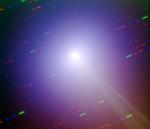 A Brighter Comet LINEAR
25.06.2001
Brighter than ever expected, comet LINEAR -- you know, the one designated C/2001 A2 -- is a sight to see in southern skies. This comet LINEAR first brightened impressively in late March as its active nucleus began to fragment, prompting some speculation that the comet might soon break up completely.
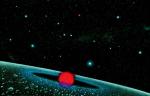 Water Found Around Nearby Star CW Leonis
16.07.2001
Do worlds outside our Solar System have oceans of water like Earth? An indication that such worlds might exist was bolstered recently by new evidence that nearby star system CW Leonis harbors water. Recent observations with the Submillimeter Wave Astronomy Satellite (SWAS) found significant detections of light at specific colors emitted by water.
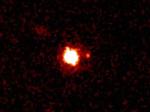 Eris: The Largest Known Dwarf Planet
18.09.2006
Is Pluto the largest dwarf planet? No! Currently, the largest known dwarf planet is (136199) Eris, renamed last week from 2003 UB313. Eris is just slightly larger than Pluto, but orbits as far as twice Pluto's distance from the Sun.
|
January February March April May June July August September October |
|||||||||||||||||||||||||||||||||||||||||||||||||