
|
You entered: Sun
 M42: Inside the Orion Nebula
8.04.2014
The Great Nebula in Orion, an immense, nearby starbirth region, is probably the most famous of all astronomical nebulas. Here, glowing gas surrounds hot young stars at the edge of an immense interstellar molecular cloud only 1500 light-years away.
 Ou4: A Giant Squid Nebula
18.07.2014
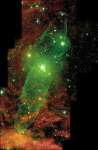
A mysterious, squid-like apparition, this nebula is very faint, but also very large in planet Earth's sky. In the mosaic image, composed with narrowband data from the 2.5 meter Isaac Newton Telescope, it spans some 2.5 full moons toward the constellation Cepheus.
 Trifid, Lagoon, and Mars
6.10.2016
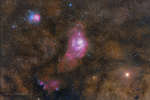
Bright nebulae and star clusters along this 5 degree wide field of view are popular stops on telescopic tours of the constellation Sagittarius and the crowded starfields of the central Milky Way. Cataloged...
 Dawn s Early Light, Rocket s Red Glare
4.07.2018
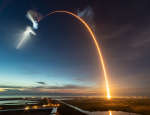
If you saw the dawn's early light from Cape Canaveral Air Force Station last Friday, June 29, then you could have seen this rocket's red glare. The single 277-second long exposure, made...
 APOD: 2023 January 31 Б A Triple View of Comet ZTF
31.01.2023
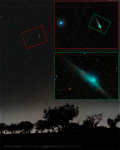
Comet ZTF has a distinctive shape. The now bright comet visiting the inner Solar System has been showing not only a common dust tail, ion tail, and green gas coma, but also an uncommonly distinctive antitail.
 Cat s Eye Wide and Deep
25.05.2023
The Cat's Eye Nebula (NGC 6543) is one of the best known planetary nebulae in the sky. Its more familiar outlines are seen in the brighter central region of the nebula in this impressive wide-angle view. But this wide and deep image combining data from two telescopes also reveals its extremely faint outer halo.
 APOD: 2025 January 27 Б Pleiades over Half Dome
27.01.2025
Stars come in bunches. The most famous bunch of stars on the sky is the Pleiades, a bright cluster that can be easily seen with the unaided eye. The Pleiades lies only about 450 light years away, formed about 100 million years ago, and will likely last about another 250 million years.
APOD: 2026 April 22 Б Earthset with an iPhone
22.04.2026
What does it mean for the Earth to set? Artemis II Commander Reid Wiseman gave us another spectacular view of Earth from their historic flyby of the Moon. Commander Wiseman's video, taken with an iPhone at 8x zoom, shows our entire planet gradually blocked from view by the Moon.
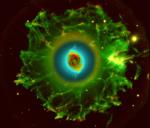 Halo of the Cat's Eye
4.09.2002
The Cat's Eye Nebula (NGC 6543) is one of the best known planetary nebulae in the sky. Its haunting symmetries are seen in the very central region of this stunning false-color picture, processed...
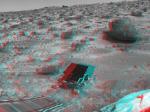 Mars: Yogi And Friends in 3D
16.07.1997
A ramp from the Pathfinder lander, the Sojourner robot rover, airbags, a couch, Barnacle Bill, and Yogi Rock appear together in this 3D stereo view of the surface of Mars. Barnacle Bill is the rock just left of the solar-paneled Sojourner and Yogi is the big friendly-looking boulder at the right.
|
January February March April May June July August September October |
|||||||||||||||||||||||||||||||||||||||||||||||||