
|
You entered: telescope
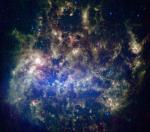 The Large Magellanic Cloud in Infrared
4.09.2006
Where does dust collect in galaxies? To help find out, a team of researchers took the most detailed image ever of gas clouds and dust in the neighboring Large Magellanic Cloud (LMC) galaxy.
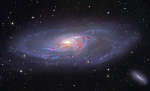 Messier 106
9.04.2021
Close to the Great Bear (Ursa Major) and surrounded by the stars of the Hunting Dogs (Canes Venatici), this celestial wonder was discovered in 1781 by the metric French astronomer Pierre Mechain. Later, it was added to the catalog of his friend and colleague Charles Messier as M106.
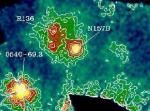 Ultra Fast Pulsar
11.02.1998
Pulsars are rotating neutron stars, born in the violent crucibles of supernova explosions. Like cosmic lighthouses, beams of radiation from surface hotspots sweep past our viewpoint creating pulses which reveal the rotation rates of these incredibly dense stellar corpses. The most famous pulsar of all is found in the nearby supernova remnant, the Crab Nebula.
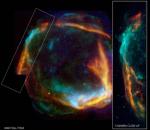 APOD: 2006 September 28- RCW 86: Historical Supernova Remnant
28.09.2006
In 185 AD, Chinese astronomers recorded the appearance of a new star in the Nanmen asterism - a part of the sky identified with Alpha and Beta Centauri on modern star charts. The new star was visible for months and is thought to be the earliest recorded supernova.
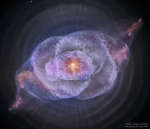 The Cats Eye Nebula in Optical and X-ray
7.11.2021
To some it looks like a cat's eye. To others, perhaps like a giant cosmic conch shell. It is actually one of brightest and most highly detailed planetary nebula known, composed of gas expelled in the brief yet glorious phase near the end of life of a Sun-like star.
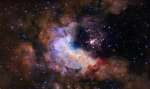 Celestial Fireworks: Into Star Cluster Westerlund 2
4.07.2017
What if you could go right into a cluster where stars are forming? A one-minute, time-lapse, video visualization of just this has been made with 3D computer modeling of the region surrounding the star cluster Westerlund 2, based on images from the Hubble Space Telescope in visible and infrared light.
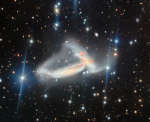 APOD: 2026 September 4 Б Na Uhane Mahoe Huki Pu i ke Ola
4.09.2026
Nд йUhane Mдhoe Huki Pе i ke Ola, is the Hawaiian name given to this image of a pair of spiral galaxies locked in a mutual gravitational embrace. Some 200 million light-years distant toward...
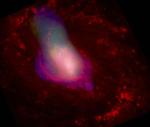 NGC 1068 and the X Ray Flashlight
11.07.2003
At night, tilting a flashlight up under your chin hides the glowing bulb from the direct view of your friends. Light from the bulb still reflects from your face though, and can give you a startling appearance.
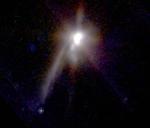 An Extrasolar Planet?
29.05.1998
This infrared Hubble Space Telescope view may contain the first ever direct image of a planet outside our own solar system. The picture shows a very young double star located about 450 light-years away toward the constellation of Taurus.
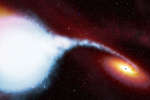 Black Hole Candidate Cygnus X 1
11.08.2008
Is that a black hole? Quite possibly. The Cygnus X-1 binary star system contains one of the best candidates for a black hole. The system was discovered because it is one of the brightest...
|
January February March April May June July August September October |
|||||||||||||||||||||||||||||||||||||||||||||||||