
|
You entered: telescope
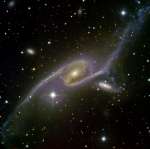 Giant Galaxy NGC 6872
3.04.2011
Over 400,000 light years across NGC 6872 is an enormous spiral galaxy, at least 4 times the size of our own, very large, Milky Way. About 200 million light-years distant, toward the southern...
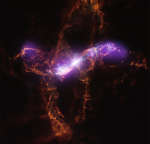 Symbiotic R Aquarii
5.02.2022
Variable star R Aquarii is actually an interacting binary star system, two stars that seem to have a close symbiotic relationship. Centered in this space-based optical/x-ray composite image it lies about 710 light years away.
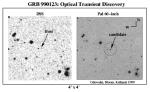 Galaxy And Gamma Ray Burst
25.01.1999
Gamma-ray bursts rule the high-energy sky and Saturday another brief, intense flash of gamma-rays from the cosmos triggered space-based detectors. The orbiting Compton Observatory's BATSE instrument quickly relayed the burst's approximate location to fast-slewing, ground-based cameras primed to search for an elusive optical flash.
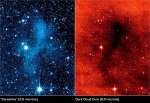 Coreshine from a Dark Cloud
30.09.2010
Stars and their planets are born in cold, dark, interstellar clouds of gas and dust. While exploring the clouds at infrared wavelengths, astronomers have made a surprising discovery -- dozens of cases where dense cloud cores shine by reflecting infrared starlight.
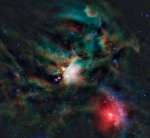 Young Stars in the Rho Ophiuchi Cloud
14.04.2011
Dust clouds and embedded newborn stars glow at infrared wavelengths in this tantalizing false-color composition from WISE, the Wide-field Infrared Survey Explorer. The cosmic canvas features one of the closest star forming regions, part of the Rho Ophiuchi cloud complex some 400 light-years distant near the southern edge of the pronounceable constellation Ophiuchus.
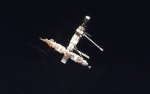 Atlantis Approaches Mir
2.04.1996
Imagine flying though space and approaching the Mir space station. The crew of the Space Shuttle Atlantis did just this in a mission that ended only two days ago. Mir, now 10 years old, is equipped for scientific experiments in astronomy, physics, materials, biology and chemistry.
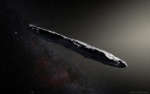 APOD: 2017 November 22 Oumuamua: Interstellar Asteroid
22.11.2017
Nothing like it has ever been seen before. The unusual space rock 'Oumuamua is so intriguing mainly because it is the first asteroid ever detected from outside our Solar System -- although likely many more are to follow given modern computer-driven sky monitoring.
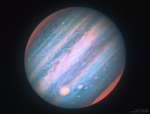 Jupiter in Infrared from Hubble
21.02.2018
Jupiter looks a bit different in infrared light. To better understand Jupiter's cloud motions and to help NASA's robotic Juno spacecraft understand the Hubble Space Telescope is being directed to regularly image the entire Jovian giant.
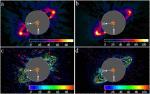 HR 4796A: Not Saturn
5.02.1999
These are not false-color renderings of the latest observations of Saturn's magnificent rings. Instead, the panels show a strikingly similar system on a much larger scale - a ring around the young, Vega-like star, HR 4796A, located about 200 light-years from Earth.
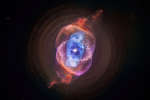 X Rays from the Cats Eye Nebula
4.08.2008
Haunting patterns within planetary nebula NGC 6543 readily suggest its popular moniker -- the Cat's Eye nebula. Starting in 1995, stunning false-color optical images from the Hubble Space Telescope detailed the swirls of this glowing nebula, known to be the gaseous shroud expelled from a dying sun-like star about 3,000 light-years from Earth.
|
January February March April May June July August September October |
|||||||||||||||||||||||||||||||||||||||||||||||||