
|
You entered: Voyager
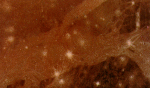 Voyager's Preview of Galileo at Ganymede
27.06.1996
NASA's robot spacecraft Galileo began its long voyage to Jupiter in October of 1989. In December of last year it arrived in the Jovian system, beginning its unprecedented, detailed exploration by dropping a probe into the gas giant's atmosphere. By early this morning it will have accomplished another milestone in its ambitious mission.
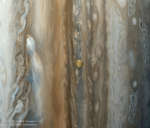 Io over Jupiter from Voyager 1
4.09.2016
Back in 1979, NASA's Voyager 1 spacecraft flew past Jupiter and its moons. The images in this mosaic, featuring the moon Io against a background of gas giant Jupiter's diffuse swirling cloud bands, were recorded by Voyager's camera from a distance of about 8.3 million kilometers.
 Voyager Views Titan s Haze
5.09.2002
Launched in 1977, 25 years ago today, the Voyager 1 spacecraft's historic tour of the outer Solar System took it past Saturn in late 1980. On November 12, 1980, Voyager 1 recorded this view looking across the edge of Titan, Saturn's largest moon, from a distance of about 22,000 kilometers.
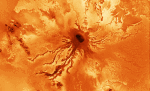 Closeup of an Io Volcano
4.08.1995
In 1979, one of NASA's Voyager spacecraft made a spectacular and unexpected discovery. Io, the innermost Galilean moon of Jupiter, was covered with volcanoes and some of them were erupting! In all, Voyager 1 observed nine volcanic eruptions during its encounter with the moon.
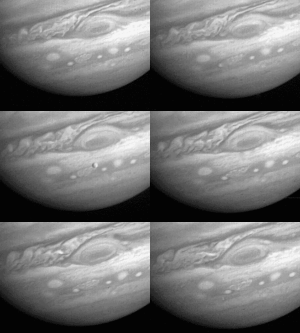 Approaching Jupiter
26.09.2000
In 1979 the Voyager 1 spacecraft compiled this view as it approached the gas giant Jupiter. Snapping a picture every time the Great Red Spot was properly aligned, the above time-lapse sequence shows not only spot rotation but also the swirling of neighboring clouds.
 Saturn's Moon Tethys
24.11.1995
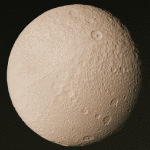
Tethys is one of the larger and closer moons of Saturn. It was visited by both Voyager spacecraft - Voyager 1 in November 1980 and by Voyager 2 in August 1981. Tethys is now known to be composed almost completely of water ice. Tethys shows a large impact crater that nearly circles the planet.
 Crescent Neptune and Triton
27.05.2023
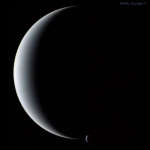
Gliding through the outer Solar System, in 1989 the Voyager 2 spacecraft looked toward the Sun to find this view of most distant planet Neptune and its moon Triton together in a crescent phase. The elegant image of ice-giant planet and largest moon was taken from behind just after Voyager's closest approach.
 Triton: Neptune's Largest Moon
23.11.1997
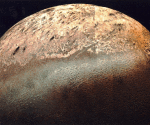
On October 10th, 1846, William Lassell was observing the newly discovered planet Neptune. He was attempting to confirm his observation, made just the previous week, that Neptune had a ring. But this time he discovered that Neptune had a satellite as well.
 Exploring Saturn's Rings
31.07.1995
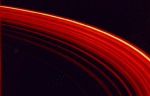
By watching a star flicker and fade as it passed behind Saturn's rings, NASA's Voyager 2 spacecraft was able explore the ring system in amazing detail. Data produced by Voyager's instruments...
 Neptune at Night
9.11.2024
Ice giant Neptune is faint in Earth's night sky. Some 30 times farther from the Sun than our fair planet, telescopes are needed to catch a glimpse of the dim and distant world. This dramatic view of Neptune's night just isn't possible for telescopes in the vicinity of planet Earth though.
|
January February March April May June July August September October |
|||||||||||||||||||||||||||||||||||||||||||||||||