
|
You entered: Voyager
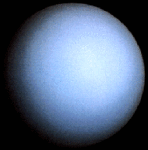 Uranus: The Tilted Planet
16.08.1995
This picture was snapped by the Voyager 2 spacecraft in 1986 - the only spacecraft ever to visit Uranus. Uranus is the third largest planet after Jupiter and Saturn. Uranus has many moons and a ring system.
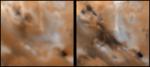 Io: The Fissure King?
29.11.1996
Is Io the solar system's Fissure King? Well, probably not ... but it is the most active volcanic moon. Active volcanoes on Jupiter's moon Io were a surprise discovery of the Voyager missions of the late 1970s.
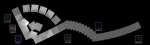 Solar System Portrait
13.02.2015
On another Valentine's Day 25 years ago, cruising four billion miles from the Sun, the Voyager 1 spacecraft looked back one last time to make this first ever Solar System family portrait. The complete portrait is a 60 frame mosaic made from a vantage point 32 degrees above the ecliptic plane.
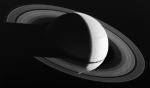 Looking Down on Saturn
21.09.1997
This picture of Saturn could not have been taken from Earth. No Earth based picture could possibly view the night side of Saturn and the corresponding shadow cast across Saturn's rings. Since Earth is much closer to the Sun than Saturn, only the day side of the planet is visible from the Earth.
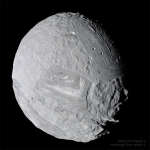 APOD: 2026 February 9 Б Miranda Revisited
9.02.2026
What is Miranda really like? Visually, old images from NASA's Voyager 2 have been recently combined and remastered to result in the featured image of Uranus's 500-kilometer-wide moon. In the late 1980s...
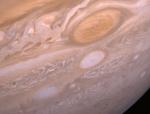 Giant Storm Systems Battle on Jupiter
5.02.2002
Two of the largest storm systems on Jupiter are colliding, and nobody is sure what will result. The larger storm is the famous Great Red Spot, while the smaller is a large white oval. Both are swirling cloud systems that circulate on Jupiter.
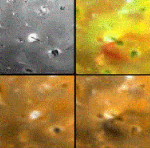 Volcano Euboea Fluctus On Io
8.09.1996
Jupiter's moon Io is turning out to be our Solar System's geologic powerhouse. The churning moon was photographed again just recently on June 27th and again shows signs of violent activity. Shown above are photographs of the volcano Euboea Fluctus taken at different times.
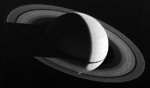 Looking Down on Saturn
17.07.1996
This picture of Saturn could not have been taken from Earth. No Earth based picture could possibly view the night side of Saturn and the corresponding shadow cast across Saturn's rings. Since Earth is much closer to the Sun than Saturn, only the day side of the planet is visible from the Earth.
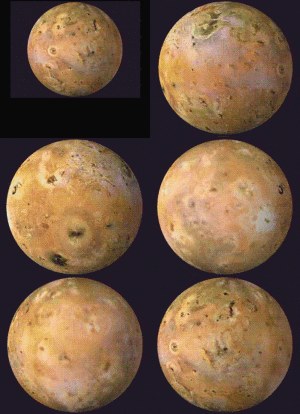 Io Rotating
24.10.2000
The surface of Io is continually changing. Jupiter's moon is the home to many powerful volcanoes so active they are effectively turning the moon inside out. The above time-lapse sequence is a composite of images taken during two space missions that approached the violent moon: Voyager and Galileo.
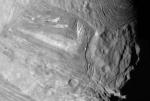 Miranda, Chevron, and Alonso
16.02.2002
Miranda is a bizarre world which surely had a tempestuous past. The innermost of the larger Uranian moons, Miranda is almost 300 miles in diameter and was discovered on today's date in 1948 by American planetary astronomer Gerard Kuiper.
|
January February March April May June July August September October |
|||||||||||||||||||||||||||||||||||||||||||||||||