
|
You entered: supernova
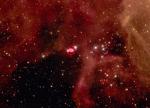 A Supernova Starfield
9.02.1999
Bright stars don't last forever. A bright star similar to others in this field exploded in a spectacular supernova that was witnessed on Earth in 1987. The result is visible even today as unusual rings and glowing gas. The above picture is a composite of recent images taken over several years.
 APOD: 2025 July 31 Б Supernova 2025rbs in NGC 7331
31.07.2025
A long time ago in a galaxy 50 million light-years away, a star exploded. Light from that supernova was first detected by telescopes on planet Earth on July 14th though, and the extragalactic transient is now known to astronomers as supernova 2025rbs.
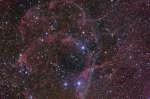 Vela Supernova Remnant
31.12.2014
The plane of our Milky Way Galaxy runs through this complex and beautiful skyscape. At the northwestern edge of the constellation Vela (the Sails) the telescopic frame is over 10 degrees wide, centered on the brightest glowing filaments of the Vela Supernova Remnant, an expanding debris cloud from the death explosion of a massive star.
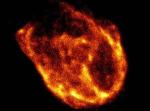 Supernova Remnant N132D in X Rays
13.09.1999
Thousands of years after a star explodes, an expanding remnant may still glow brightly. Such is the case with N132D, a supernova remnant located in the neighboring Large Magellanic Cloud galaxy. The expanding shell from this explosion now spans 80 light-years and has swept up about 600 Suns worth of mass.
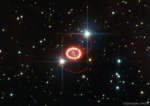 The Mysterious Rings of Supernova 1987A
5.03.2017
What's causing those odd rings in supernova 1987A? Thirty years ago, in 1987, the brightest supernova in recent history was seen in the Large Magellanic Cloud. At the center of the featured picture is an object central to the remains of the violent stellar explosion.
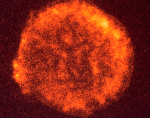 Tychos Supernova Remnant in X ray
7.03.1999
How often do stars explode? By looking at external galaxies, astronomers can guess that these events, known as a supernovae, should occur about once every 30 years in a typical spiral galaxy like our MilkyWay.
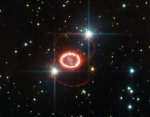 The Mysterious Rings of Supernova 1987A
26.02.2012
What's causing those odd rings in supernova 1987A? Twenty five years ago, in 1987, the brightest supernova in recent history was seen in the Large Magellanic Clouds. At the center of the above picture is an object central to the remains of the violent stellar explosion.
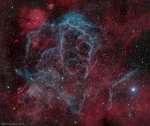 Vela Supernova Remnant
10.09.2010
The plane of our Milky Way Galaxy runs through this complex and beautiful skyscape. At the northwestern edge of the constellation Vela (the Sails) the four frame mosaic is over 10 degrees wide, centered on the glowing filaments of the Vela Supernova Remnant, the expanding debris cloud from the death explosion of a massive star.
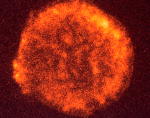 Tycho's Supernova Remnant in X-ray
23.06.1996
How often do stars explode? By looking at external galaxies, astronomers can guess that these events, known as a supernovae, should occur about once every 30 years in a typical spiral galaxy like our MilkyWay.
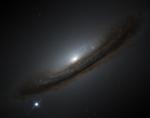 Supernova 1994D and the Unexpected Universe
30.12.1998
Far away, long ago, a star exploded. Supernova 1994D, visible as the bright spot on the lower left, occurred in the outskirts of disk galaxy NGC 4526. Supernova 1994D was not of interest for how different it was, but rather for how similar it was to other supernovae.
|
January February March April May June July August September October |
|||||||||||||||||||||||||||||||||||||||||||||||||