
|
You entered: supernova
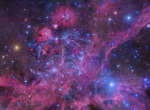 Vela Supernova Remnant Mosaic
9.01.2019
The plane of our Milky Way Galaxy runs through this complex and beautiful skyscape. Seen toward colorful stars near the northwestern edge of the constellation Vela (the Sails), the 16 degree wide, 200 frame...
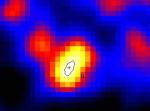 The Case of the Missing Supernova
13.04.1999
Would you notice a second Moon in the sky? About 700 years ago, light from a tremendous explosion reached Earth that should have appeared almost as bright as a full Moon. The bright spot should have lasted for weeks, yet no notation of such an occurrence has been found in historical records.
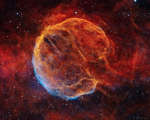 The Medulla Nebula Supernova Remnant
17.01.2021
What powers this unusual nebula? CTB-1 is the expanding gas shell that was left when a massive star toward the constellation of Cassiopeia exploded about 10,000 years ago. The star likely detonated when it ran out of elements, near its core, that could create stabilizing pressure with nuclear fusion.
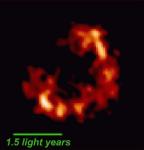 Supernova Remnant In M82
15.12.1999
This false-color radio wavelength picture of an expanding stellar debris cloud is the product of one of the largest radio astronomy experiments ever. Combining the output of 20 radio telescopes scattered around planet Earth...
 APOD: 2025 January 8 Б Supernova Remnants Big and Small
7.01.2025
What happens after a star explodes? A huge fireball of hot gas shoots out in all directions. When this gas slams into the existing interstellar medium, it heats up so much it glows. Two different supernova remnants (SNRs) are visible in the featured image, taken at the Oukaцmeden Observatory in Morocco.
 APOD: 2025 July 22 Б A Double Detonation Supernova
21.07.2025
Can some supernovas explode twice? Yes, when the first explosion acts like a detonator for the second. This is a leading hypothesis for the cause of supernova remnant (SNR) 0509-67
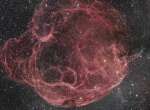 Simeis 147: Supernova Remnant
11.02.2011
It's easy to get lost following the intricate filaments in this detailed mosaic image of faint supernova remnant Simeis 147. Also cataloged as Sh2-240 and seen towards the constellation Taurus, it covers nearly 3 degrees (6 full moons) on the sky.
 APOD: 2025 June 2 Б Veil Nebula: Wisps of an Ancient Supernova
1.06.2025
Wisps like this are all that remain visible of a Milky Way star. About 7,000 years ago that star exploded in a supernova, leaving the Veil Nebula. At the time, the expanding cloud was likely as bright as a crescent Moon, remaining visible for weeks to people living at the dawn of recorded history.
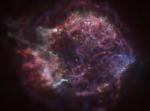 Cas A Supernova Remnant in X Rays
2.01.2000
The complex shell of a star seen to explode 300 years ago is helping astronomers to understand how that star exploded. The above recently released image of supernova remnant Cassiopeia A (Cas A) shows unprecedented detail in three X-ray colors.
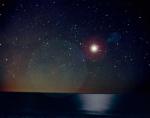 1006 AD: Supernova in the Sky
27.03.2003
A new star, likely the brightest supernova in recorded human history, appeared in planet Earth's sky in the year 1006 AD. The expanding debris cloud from the stellar explosion is still visible to modern astronomers, but what did the supernova look like in 1006?
|
January February March April May June July August September October |
|||||||||||||||||||||||||||||||||||||||||||||||||