
|
You entered: supernova
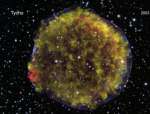 Tychos Supernova Remnant Expands
1.06.2016
What star created this huge expanding puffball? Featured here is the first expansion movie ever created for Tycho's supernova remnant, the result of a stellar explosion first recorded over 400 years ago by the famous astronomer Tycho Brahe.
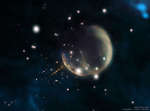 Supernova Cannon Expels Pulsar J0002
2.10.2022
What could shoot out a neutron star like a cannon ball? A supernova. About 10,000 years ago, the supernova that created the nebular remnant CTB 1 not only destroyed a massive star but blasted its newly formed neutron star core -- a pulsar -- out into the Milky Way Galaxy.
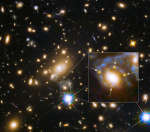 Galaxy and Cluster Create Four Images of Distant Supernova
8.03.2015
What are the unusual spots surrounding that galaxy? They are all images of the same supernova. For the first time, a single supernova explosion has been seen split into multiple images by the gravitational lens deflections of intervening masses. In this case the masses are a large galaxy and its home galaxy cluster.
 APOD: 2023 October 11 Б NGC 1097: Spiral Galaxy with Supernova
11.10.2023
What's happening in the lower arm of this spiral galaxy? A supernova. Last month, supernova SN 2023rve was discovered with UAE's Al-Khatim Observatory and later found to be consistent with the death explosion of a massive star, possibly leaving behind a black hole.
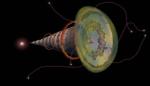 Cosmic Rays and Supernova Dust
18.06.1998
Cosmic Rays are celestial high energy particles traveling at nearly the speed of light, which constantly bombard the Earth. Discovered during high altitude balloon flights in 1912 their source has been a long standing mystery.
 SN 1006 Supernova Remnant
4.07.2008
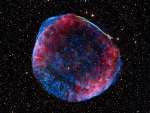
A new star, likely the brightest supernova in recorded human history, lit up planet Earth's sky in the year 1006 AD. The expanding debris cloud from the stellar explosion, found in the southerly constellation of Lupus, still puts on a cosmic light show across the electromagnetic spectrum.
 Supernova Survivor
10.09.2005
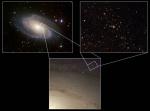
Beginning with a full view of beautiful spiral galaxy M81, follow the insets (left, bottom, then right) to zoom in on a real survivor. Seen at the center of the final field on the right is a star identified as the survivor of a cosmic cataclysm -- the supernova explosion of its companion star.
 Supernova Remnant E0102 72
5.09.2009
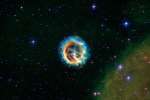
The expanding debris cloud from the explosion of a massive star is captured in this multiwavelength composite, combining x-ray and optical images from the Chandra and Hubble telescopes. Identified as E0102-72, the supernova remnant lies about 190,000 light-years away in our neighboring galaxy, the Small Magellanic Cloud.
 Supernova Remnant Cassiopeia A
17.01.2025
Massive stars in our Milky Way Galaxy live spectacular lives. Collapsing from vast cosmic clouds, their nuclear furnaces ignite and create heavy elements in their cores. After only a few million years for the most massive stars, the enriched material is blasted back into interstellar space where star formation can begin anew.
 Supernova Remnant Cassiopeia A
6.02.2026
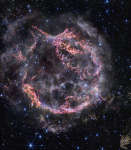
Massive stars in our Milky Way Galaxy live spectacular lives. Collapsing from vast cosmic clouds, their nuclear furnaces ignite and create heavy elements in their cores. After only a few million years for the most massive stars, the enriched material is blasted back into interstellar space where star formation can begin anew.
|
January February March April May June July August September October |
|||||||||||||||||||||||||||||||||||||||||||||||||