
|
You entered: supernova
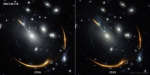 SN Requiem: A Supernova Seen Three Times So Far
2.11.2021
We've seen this same supernova three times -- when will we see it a fourth? When a distant star explodes in a supernova, we're lucky if we see it even once.
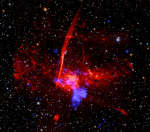 APOD: 2026 June 18 Б Possible Supernova Remnant in Galactic Center
18.06.2026
Do you see that blue blob to the lower right of the image center? Astronomers think that it shows where a massive star exploded as a supernova whose light reached Earth 1,700 years ago.
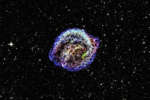 Kepler's Supernova Remnant in X Rays
15.05.2013
What caused this mess? Some type of star exploded to create the unusually shaped nebula known as Kepler's supernova remnant, but which type? Light from the stellar explosion that created this energized cosmic cloud was first seen on planet Earth in October 1604, a mere four hundred years ago.
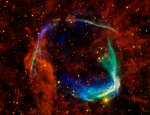 RCW 86: Historical Supernova Remnant
10.11.2011
In 185 AD, Chinese astronomers recorded the appearance of a new star in the Nanmen asterism - a part of the sky identified with Alpha and Beta Centauri on modern star charts. The new star was visible for months and is thought to be the earliest recorded supernova.
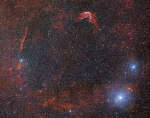 RCW 86: Historical Supernova Remnant
3.03.2023
In 185 AD, Chinese astronomers recorded the appearance of a new star in the Nanmen asterism. That part of the sky is identified with Alpha and Beta Centauri on modern star charts. The new star was visible to the naked-eye for months, and is now thought to be the earliest recorded supernova.
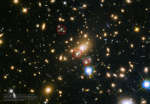 SN Refsdal: The First Predicted Supernova Image
21.12.2015
It's back. Never before has an observed supernova been predicted. The unique astronomical event occurred in the field of galaxy cluster MACS J1149.5+2223. Most bright spots in the featured image are galaxies in this cluster.
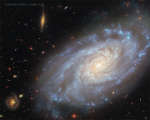 APOD: 2025 November 5 Б Spiral Galaxy NGC 3370 from Hubble
5.11.2025
Is this what our own Milky Way Galaxy looks like from far away? Similar in size and grand design to our home Galaxy (although without the central bar), spiral galaxy NGC 3370 lies about 100 million light-years away toward the constellation of the Lion (Leo).
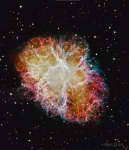 APOD: 2025 December 29 Б M1: The Crab Nebula
29.12.2025
This is the mess that is left when a star explodes. The Crab Nebula, the result of a supernova seen in 1054 AD, is filled with mysterious filaments. The filaments are not only tremendously...
 No X rays from SN 2014J
16.08.2014
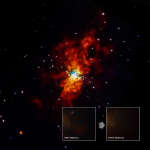
Last January, telescopes in observatories around planet Earth were eagerly used to watch the rise of SN 2014J, a bright supernova in nearby galaxy M82. Still, the most important observations may have been from orbit where the Chandra X-ray Observatory saw nothing.
 72.6: Oxygen Supply
28.05.2003
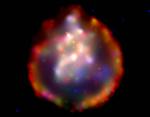
A supernova explosion, a massive star's inevitable and spectacular demise, blasts back into space debris enriched in the heavy elements forged in its stellar core. Incorporated into future stars and planets, these are the elements ultimately necessary for life.
|
January February March April May June July August September October |
|||||||||||||||||||||||||||||||||||||||||||||||||