
|
You entered: supernova
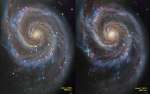 Supernovae in the Whirlpool
11.06.2011
Where do spiral galaxies keep their supernovae? Near their massive star forming regions, of course, and those regions tend to lie along sweeping blue spiral arms. Because massive stars are very short-lived, they don't have a chance to wander far from their birth place.
 APOD: 2025 August 8 Б Dawn of the Crab
8.08.2025
One of the all-time historic skyscapes occured in July 1054, when the Crab Supernova blazed into the dawn sky. Chinese court astrologers first saw the Guest Star on the morning of 4 July 1054 next to the star Tianguan (now cataloged as Zeta Tauri).
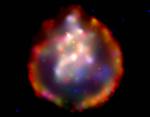 SNR 0103 72.6: Oxygen Supply
13.08.2005
A supernova explosion, a massive star's inevitable and spectacular demise, blasts back into space debris enriched in the heavy elements forged in its stellar core. Incorporated into future stars and planets, these are the elements ultimately necessary for life. Seen here in a false-color x-ray image, supernova remnant SNR 0103-72
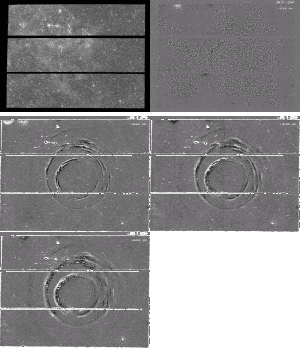 The Expanding Light Echoes of SN 1987A
25.01.2006
Can you find supernova 1987A? It isn't hard -- it occurred at the center of the expanding bullseye pattern. Although this stellar detonation was first seen almost two decades ago, light from it continues to bounce off clumps of interstellar dust and be reflected to us today.
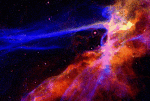 Rampaging Fronts of the Veil Nebula
7.03.1996
A supernova explosion of a high-mass star results in fast moving blast waves. At the front of the waves shown above, ionized gas in the Veil Supernova Remnant rushes out from the explosion, sweeps up material, and breaks up many atoms into constituent ions and electrons.
 SN1987A s Cosmic Pearls
20.02.2004
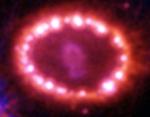
In February 1987, light from the brightest stellar explosion seen in modern times reached Earth -- supernova SN1987A. This Hubble Space Telescope image from the sharp Advanced Camera for Surveys taken in November 2003 shows the explosion site over 16 years later.
 Kepler s SNR from Chandra, Hubble, Spitzer
8.10.2004
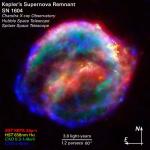
Light from the stellar explosion that created this energized cosmic cloud was first seen on planet Earth in October 1604, a mere four hundred years ago. The supernova produced a bright new star in early 17th century skies within the constellation Ophiucus.
 Art and Science in NGC 981
12.11.2009
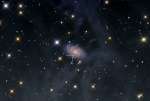
This beautiful telescopic skyscape features spiral galaxy NGC 981. The island universe is about 50,000 light-years across and lies some 60 million light-years away toward the constellation Aries. An artistic presentation, the image...
 A Radio Vista of Cygnus
18.02.2002
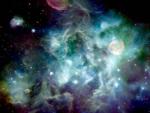
Shells of ancient supernovas, cocoons surrounding newborn stars, and specks from distant quasars highlight this tremendous vista toward the constellation of Cygnus. The representative color image covers about 10 degrees across on the sky but is only a small part of the Canadian Galactic Plane Survey in radio light.
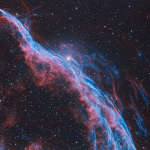 NGC 6960: The Witch s Broom Nebula
29.05.2013
Ten thousand years ago, before the dawn of recorded human history, a new light would have suddenly have appeared in the night sky and faded after a few weeks. Today we know this light was from a supernova, or exploding star, and record the expanding debris cloud as the Veil Nebula, a supernova remnant.
|
January February March April May June July August September October |
|||||||||||||||||||||||||||||||||||||||||||||||||