
|
You entered: supernova
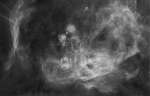 The Gum Nebula Expanse
24.05.2018
Named for a cosmic cloud hunter, Australian astronomer Colin Stanley Gum (1924-1960), The Gum Nebula is so large and close it is actually hard to see. In fact, we are only about 450 light-years from the front edge and 1,500 light-years from the back edge of this interstellar expanse of glowing hydrogen gas.
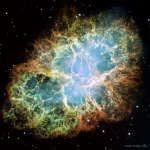 M1: The Crab Nebula from Hubble
16.08.2015
This is the mess that is left when a star explodes. The Crab Nebula, the result of a supernova seen in mysterious filaments. The filaments are not only tremendously complex, but appear to have less mass than expelled in the original supernova and a higher speed than expected from a free explosion.
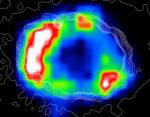 X-Ray Ring Around SN1987A
12.05.2000
This false-color image from the Chandra X-ray Observatory reveals a one light-year diameter ring of hot, ten million degree plasma. It is one of the most detailed X-ray images of the expanding blast wave from supernova 1987A (SN1987A).
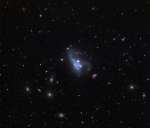 NGC 3239 and SN 2012A
27.01.2012
About 40,000 light-years across, pretty, irregular galaxy NGC 3239 lies near the center of this lovely field of galaxies in the galaxy rich constellation Leo. At a distance of only 25 million light-years...
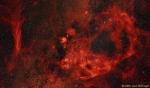 The Gum Nebula
19.05.2006
Named for Australian astronomer Colin Stanley Gum (1924-1960), The Gum Nebula is so large and close it is actually hard to see. In fact, we are only about 450 light-years from the front edge and 1,500 light-years from the back edge of this cosmic cloud of glowing hydrogen gas.
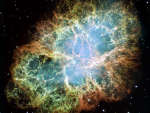 M1: The Crab Nebula from Hubble
17.02.2008
This is the mess that is left when a star explodes. The Crab Nebula, the result of a supernova seen in 1054 AD, is filled with mysterious filaments. The filaments are not only tremendously...
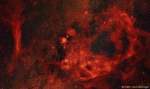 The Gum Nebula
22.08.2009
Named for Australian astronomer Colin Stanley Gum (1924-1960), The Gum Nebula is so large and close it is actually hard to see. In fact, we are only about 450 light-years from the front edge and 1,500 light-years from the back edge of this cosmic cloud of glowing hydrogen gas.
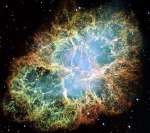 M1: The Crab Nebula from Hubble
25.10.2009
This is the mess that is left when a star explodes. The Crab Nebula, the result of a supernova seen in 1054 AD, is filled with mysterious filaments. The filaments are not only tremendously...
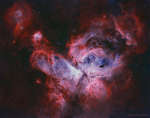 The Great Nebula in Carina
25.04.2022
In one of the brightest parts of Milky Way lies a nebula where some of the oddest things occur. NGC 3372, known as the Great Nebula in Carina, is home to massive stars and changing nebulas. The Keyhole Nebula (NGC 3324), the bright structure just below the image center, houses several of these massive stars.
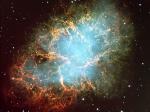 The Crab Nebula from VLT
25.03.2001
The Crab Nebula, filled with mysterious filaments, is the result of a star that was seen to explode in 1054 AD. This spectacular supernova explosion was recorded by Chinese and (quite probably) Anasazi Indian astronomers.
|
January February March April May June July August September October |
|||||||||||||||||||||||||||||||||||||||||||||||||