
|
You entered: supernova
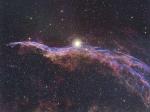 NGC 6960: The Witchs Broom Nebula
2.03.2004
Ten thousand years ago, before the dawn of recorded human history, a new light must suddenly have appeared in the night sky and faded after a few weeks. Today we know this light was an exploding star and record the colorful expanding cloud as the Veil Nebula.
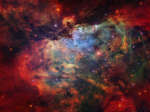 APOD: 2026 June 10 Б The Eagle Nebula and Friends
10.06.2026
What looks as if it is going to swallow the great Pillars of Creation? The Eagle Nebula (M16) is not a bird, a plane, or Superman. M16 is actually a combination of several celestial objects. NGC 6611 is the young star cluster that appears to peak out beneath the EagleБs БwingsБ.
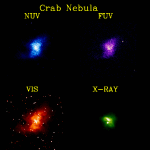 The High Energy Crab Nebula
9.09.1996
This is the mess that is left when a star explodes. The Crab Nebula is so energetic that it glows in every kind of light known. Shown above are images of the Crab Nebula from visible light to the X-ray band.
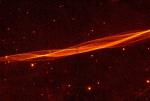 Filaments in the Cygnus Loop
18.01.2003
Subtle and delicate in appearance, these are filaments of shocked interstellar gas -- part of the expanding blast wave from a violent stellar explosion. Recorded in November 1997 with the Wide Field and Planetary Camera 2 on board the Hubble Space Telescope, the picture is a closeup of a supernova remnant known as the Cygnus Loop.
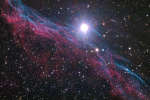 NGC 6960: The Witch s Broom Nebula
19.08.2008
Ten thousand years ago, before the dawn of recorded human history, a new light must suddenly have appeared in the night sky and faded after a few weeks. Today we know this light was an exploding star and record the colorful expanding cloud as the Veil Nebula.
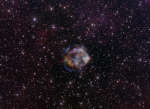 Cas A: Optical and X ray
17.01.2013
The aftermath of a cosmic cataclysm, supernova remnant Cassiopeia A (Cas A) is a comfortable 11,000 light-years away. Light from the Cas A supernova, the death explosion of a massive star, first reached Earth just 330 years ago.
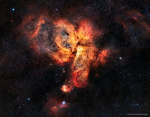 The Great Nebula in Carina
13.06.2017
In one of the brightest parts of Milky Way lies a nebula where some of the oddest things occur. NGC 3372, known as the Great Nebula in Carina, is home to massive stars and changing nebulas.
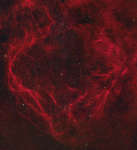 RCW 114: A Dragon s Heart in Ara
11.01.2018
Large and dramatically shaped, this cosmic cloud spans nearly 7 degrees or 14 full moons across planet Earth's sky toward the southern constellation Ara. Difficult to image, the filamentary apparition is cataloged as RCW 114 and traced in this telescopic mosaic by the telltale reddish emission of ionized hydrogen atoms.
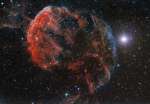 The Elusive Jellyfish Nebula
9.01.2013
Normally faint and elusive, the Jellyfish Nebula is caught in this alluring telescopic view. Drifting near bright star Eta Geminorum, at the foot of a celestial twin, the Jellyfish Nebula is seen dangling tentacles from the bright arcing ridge of emission left of center.
 APOD: 2023 December 26 Б IC 443: The Jellyfish Nebula
26.12.2023
Why is this jellyfish swimming in a sea of stars? Drifting near bright star Eta Geminorum, seen at the right, the Jellyfish Nebula extends its tentacles from the bright arcing ridge of emission left of center.
|
January February March April May June July August September October |
|||||||||||||||||||||||||||||||||||||||||||||||||