
|
You entered: supernova
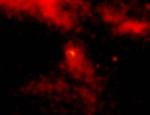 Pulsar Wind in the Vela Nebula
19.07.2001
The Vela pulsar was born 10,000 years ago at the center of a supernova -- an exploding star. In this Chandra Observatory x-ray image, the pulsar still produces a glowing nebula at the heart of the expanding cloud of stellar debris.
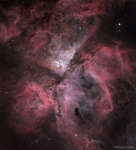 The Great Nebula in Carina
23.03.2016
In one of the brightest parts of Milky Way lies a nebula where some of the oddest things occur. NGC 3372, known as the Great Nebula in Carina, is home to massive stars and changing nebulas.
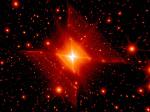 MWC 922: The Red Square Nebula
16.04.2007
What could cause a nebula to appear square? No one is quite sure. The hot star system known as MWC 922, however, appears to be imbedded in a nebula with just such a shape. The above image combines infrared exposures from the Hale Telescope on Mt.
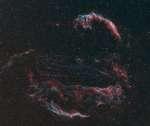 The Veil Nebula
16.09.2010
Delicate in appearance, these filaments of shocked, glowing gas, draped in planet Earth's sky toward the constellation of Cygnus, make up the Veil Nebula. The nebula is a large supernova remnant, an expanding cloud born of the death explosion of a massive star.
 Cooling Neutron Star
5.03.2011
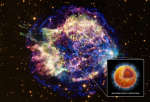
Supernova remnant Cassiopeia A (Cass A) is a comfortable 11,000 light-years away. Light from the Cass A supernova, the death explosion of a massive star, first reached Earth just 330 years ago.
 M82: Starburst in X-rays
21.04.2000
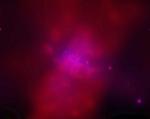
Star formation occurs at a faster pace in M82 -- a galaxy with about 10 times the rate of massive star birth (and death) compared to our Milky Way. Winds from massive stars and blasts...
 APOD: 2025 October 28 Б NGC 6995: The Bat Nebula
28.10.2025
Can you see the bat? It haunts this cosmic close-up of the eastern Veil Nebula. The Veil Nebula itself is a large supernova remnant, the expanding debris cloud from the death explosion of a massive star.
 The High Energy Crab Nebula
22.11.1998
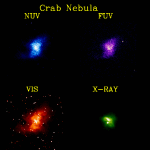
This is the mess that is left when a star explodes. The Crab Nebula is so energetic that it glows in every kind of light known. Shown above are images of the Crab Nebula from visible light to the X-ray band.
 MWC 922: The Red Square Nebula
23.03.2011
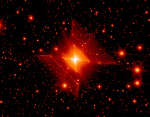
What could cause a nebula to appear square? No one is quite sure. The hot star system known as MWC 922, however, appears to be embedded in a nebula with just such a shape. The above image combines infrared exposures from the Hale Telescope on Mt.
 MWC 922: The Red Square Nebula
16.12.2012
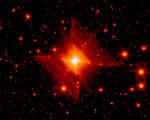
What could cause a nebula to appear square? No one is quite sure. The hot star system known as MWC 922, however, appears to be embedded in a nebula with just such a shape. The above image combines infrared exposures from the Hale Telescope on Mt.
|
January February March April May June July August September October |
|||||||||||||||||||||||||||||||||||||||||||||||||