
|
You entered: supernova
 Sharpless 249 and the Jellyfish Nebula
2.12.2014
Normally faint and elusive, the Jellyfish Nebula is caught in this alluring telescopic mosaic. The scene is anchored right and left by two bright stars, Mu and Eta Geminorum, at the foot of the celestial twin while the Jellyfish Nebula is the brighter arcing ridge of emission with dangling tentacles below and right of center.
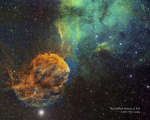 Sharpless 249 and the Jellyfish Nebula
7.01.2017
Normally faint and elusive, the Jellyfish Nebula is caught in this alluring telescopic mosaic. The scene is anchored below by bright star Eta Geminorum, at the foot of the celestial twin, while the Jellyfish Nebula is the brighter arcing ridge of emission with tentacles dangling below and left of center.
 The Nebulous Realm of WR 134
31.05.2024
Made with narrowband filters, this cosmic snapshot covers a field of view over twice as wide as the full Moon within the boundaries of the constellation Cygnus. It highlights the bright edge of a ring-like nebula traced by the glow of ionized hydrogen and oxygen gas.
 Thors Helmet
20.12.2022
Thor not only has his own day (Thursday), but a helmet in the heavens. Popularly called Thor's Helmet, NGC 2359 is a hat-shaped cosmic cloud with wing-like appendages. Heroically sized even for a Norse god, Thor's Helmet is about 30 light-years across.
 Structure in N63A
1.01.2004
Shells and arcs abound in this false-color, multiwavelength view of supernova remnant N63A, the debris of a massive stellar explosion. The x-ray emission (blue), is from gas heated to 10 million degrees C as knots of fast moving material from the cosmic blast sweep up surrounding interstellar matter.
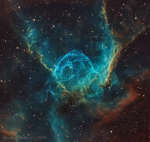 Thors Helmet
20.07.2021
Thor not only has his own day (Thursday), but a helmet in the heavens.б Popularly called Thor's Helmet, NGC 2359 is a hat-shaped cosmic cloud with wing-like appendages. Heroically sized even for a Norse god, Thor's Helmet is about 30 light-years across.
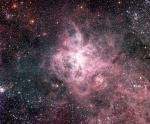 The Tarantula Zone
23.08.2003
The Tarantula Nebula is more than 1,000 light-years across - a giant emission nebula within our neighboring galaxy the Large Magellanic Cloud. Inside this cosmic arachnid lies a central young cluster of massive stars, cataloged as R136, whose intense radiation and strong winds have helped energize the nebular glow and shape the spidery filaments.
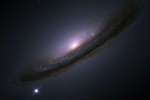 Signals of a Strange Universe
29.03.2009
Eleven years ago results were first presented indicating that most of the energy in our universe is not in stars or galaxies but is tied to space itself. In the language of cosmologists, a large cosmological constant is directly implied by new distant supernovae observations.
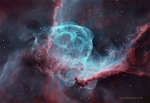 APOD: 2026 June 9 Б Thors Helmet
9.06.2026
Thor not only has his own day (Thursday), but a helmet in the heavens. Popularly called Thor's Helmet, NGC 2359 is a hat-shaped cosmic cloud with wing-like appendages. Heroically sized even for a Norse god, Thor's Helmet is about 30 light-years across.
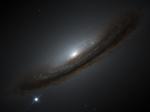 Rumors of a Strange Universe
24.12.2006
Eight years ago results were first presented indicating that most of the energy in our universe is not in stars or galaxies but is tied to space itself. In the language of cosmologists, a large cosmological constant is directly implied by new distant supernovae observations.
|
January February March April May June July August September October |
|||||||||||||||||||||||||||||||||||||||||||||||||