
|
You entered: supernova
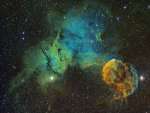 The Elusive Jellyfish Nebula
15.05.2010
Normally faint and elusive, the Jellyfish Nebula is caught in this alluring, false-color, telescopic view. Flanked by two bright stars, Mu and Eta Geminorum, at the foot of a celestial twin, the Jellyfish Nebula is the brighter arcing ridge of emission with dangling tentacles below and right of center.
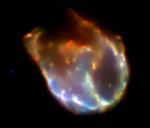 N132D and the Color of X Rays
23.05.2002
Supernova remnant N132D shows off complex structures in this sharp, color x-ray image. Still, overall this cosmic debris from a massive star's explosive death has a strikingly simple horseshoe shape. While N132D lies 180,000 light-years distant in the Large Magellanic Cloud, the expanding remnant appears here about 80 light-years across.
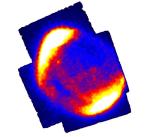 SN 1006: Pieces of the Cosmic Ray Puzzle
2.12.2000
Research balloon flights conducted in 1912 by Austrian physicist Victor Hess revealed that the Earth was constantly bombarded by high energy radiation from space - which came to be called "Cosmic Rays". What are Cosmic Rays and where do they come from?
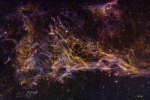 Pickerings Triangle from Kitt Peak
1.07.2008
Wisps like this are all that remain visible of a Milky Way star. About 7,500 years ago that star exploded in a supernova leaving the Veil Nebula, also known as the Cygnus Loop.
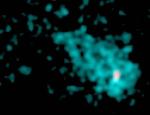 IC443's Neutron Star
15.12.2000
Using x-ray data from the orbiting Chandra Observatory along with radio data from the Very Large Array, a team of researchers has discovered evidence for a new example of one of the most bizarre objects known to modern astrophysics -- a neutron star.
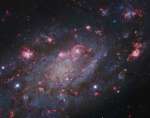 NGC 2403 in Camelopardalis
23.07.2011
Magnificent island universe NGC 2403 stands within the boundaries of the long-necked constellation Camelopardalis. Some 10 million light-years distant and about 50,000 light-years across, the spiral galaxy also seems to have more than its fair share of giant star forming HII regions, marked by the telltale reddish glow of atomic hydrogen gas.
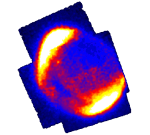 SN 1006: Pieces of the Cosmic Ray Puzzle
16.10.1996
Research balloon flights conducted in 1912 by Austrian physicist Victor Hess revealed that the Earth was constantly bombarded by high energy radiation from space - which came to be called "Cosmic Rays". What are Cosmic Rays and where do they come from?
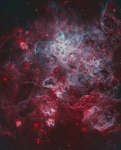 The Tarantula Zone
13.11.2020
The Tarantula Nebula, also known as 30 Doradus, is more than a thousand light-years in diameter, a giant star forming region within nearby satellite galaxy the Large Magellanic Cloud. About 180 thousand light-years away, it's the largest, most violent star forming region known in the whole Local Group of galaxies.
 APOD: 2023 November 21 Б Flemings Triangular Wisp
21.11.2023
These chaotic and tangled filaments of shocked, glowing gas are spread across planet Earth's sky toward the constellation of Cygnus as part of the Veil Nebula. The Veil Nebula itself is a large supernova remnant, an expanding cloud born of the death explosion of a massive star.
 DEM L71: When Small Stars Explode
14.03.2003
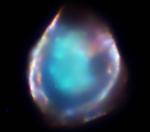
Large, massive stars end their furious lives in spectacular supernova explosions -- but small, low mass stars may encounter a similar fate. In fact, instead of simply cooling off and quietly fading away, some white...
|
January February March April May June July August September October |
|||||||||||||||||||||||||||||||||||||||||||||||||