
|
You entered: supernova
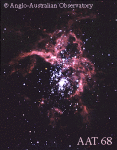 The Violent Star Cluster 30 Doradus
23.05.1996
The largest, most violent star forming region known in the whole Local Group of galaxies lies in our neighboring galaxy the LMC. Were 30 Doradus at the distance of the Orion Nebula -- a local star forming region -- it would take up fully half the sky.
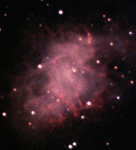 M1: The Crab Nebula
25.07.1995
In the year 1054 a star in the constellation of Taurus exploded in a spectacular supernova so bright it appeared to dominate the sky except for the Sun and Moon for many days. It left behind one of the most brilliant nebulae, listed first in Charles Messier's list of nebulous sky objects.
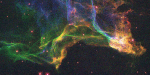 The Cygnus Loop
26.07.1996
15,000 years ago a star in the constellation of Cygnus exploded -- the shockwave from this supernova explosion is still expanding into interstellar space! The collision of this fast moving wall of gas with...
 A Distant Destiny
14.01.1998
Watching galaxies recede, observational astronomers of the 20th century discovered an astounding fact - the Universe is expanding. Will it continue to expand forever? The speed of light is finite so looking into the distant Universe is equivalent to looking at the distant past.
 On the Origin of Gold
15.05.2005
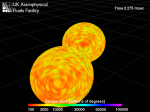
Where did the gold in your jewelry originate? No one is completely sure. The relative average abundance in our Solar System appears higher than can be made in the early universe, in stars, and even in typical supernova explosions.
 Maria Mitchell Inspires a Generation
1.10.1997
"Do not look at stars as bright spots only - try to take in the vastness of the universe." Today is the 150th anniversary of the day Maria Mitchell swept the sky with her telescope and discovered the comet of 1847 (comet Mitchell 1847VI).
 On the Origin of Gold
5.04.2001
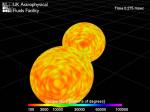
Where did the gold in your jewelry originate? No one is completely sure. The relative average abundance in our Solar System appears higher than can be made in the early universe, in stars, and even in typical supernova explosions. Some astronomers now
 Seven Jets from Comet Hale-Bopp
13.11.1996
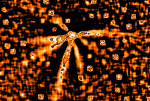
Comet Hale-Bopp is turning out to be quite unusual. One reason is the great amount of jet activity at such a large distance from the Sun. In the above false-color image, no less than seven jets can be seen emanating from Hale-Bopp's coma.
 Tarantula
4.06.1997
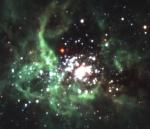
NGC 2070 is an immense star forming region in a nearby galaxy known as the Large Magellanic Cloud. Its spidery appearance is responsible for its popular name, "The Tarantula Nebula", except that this tarantula is about 1,000 light-years across, and 165,000 light-years away in the southern constellation Dorado.
 Stellar Laboratories in the LMC
25.07.1997
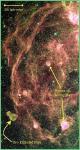
Stars are evolving in the Large Magellanic Clouds (LMC). This is particularly evident in the above close-up of the LMC's edge, which appears about as large as the full moon. Visible only...
|
January February March April May June July August September October |
|||||||||||||||||||||||||||||||||||||||||||||||||