
|
You entered: supernova
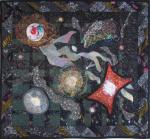 What the Hubble Saw
25.11.2004
In this striking 41 inch by 38 inch quilt, astronomy enthusiast Judy Ross has interpreted some of the Hubble Space Telescope's best galactic and extragalactic vistas. Featured in past APODs, clockwise from...
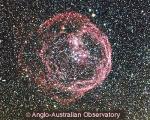 Henize 70: A SuperBubble In The LMC
13.06.1998
Stars with tens of times the mass of the Sun profoundly affect their galactic environment. Churning and mixing the interstellar gas and dust clouds they leave their mark in the compositions and locations of future generations of stars and star systems.
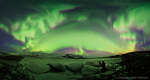 Aurora Over Iceland
21.03.2012
If you see a sky like this -- photograph it. Three nights ago in Iceland, an adventurous photographer (pictured) chanced across a sky full of aurora and did just that. Afterwards, by stitching together five smaller photographs, the entire aurora-lit sky was recreated in this 180-degree panorama taken from VatnajЖkull glacier.
 The Frothy Milky Way
9.10.1999
Astronomers have discovered that looking at dust along the plane of our Milky Way Galaxy is a bit like looking into a frothy glass of beer. The dust between stars in our galaxy appears...
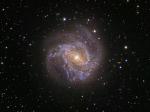 Spiral Galaxy M83: The Southern Pinwheel
24.07.2007
M83 is one of the closest and brightest spiral galaxies on the sky. Visible with binoculars in the constellation of Hydra, majestic spiral arms have prompted its nickname as the Southern Pinwheel. Although discovered...
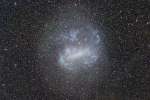 A Large Magellanic Cloud Deep Field
9.04.2008
Is this a spiral galaxy? No. Actually, it is the Large Magellanic Cloud (LMC), the largest satellite galaxy of our own Milky Way Galaxy. The LMC is classified as a dwarf irregular galaxy because of its normally chaotic appearance. In this deep and wide exposure, however, the full extent of the LMC becomes visible.
 The Frothy Milky Way
24.04.1997
Astronomers have recently discovered that looking at dust along the plane of our Milky Way Galaxy is a bit like looking into a frothy glass of beer. The dust between stars in our galaxy...
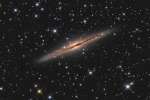 Edge on Spiral Galaxy NGC 891
25.02.2010
This beautiful cosmic portrait features NGC 891. The spiral galaxy spans about 100 thousand light-years and is seen almost exactly edge-on from our perspective. In fact, about 30 million light-years distant in the constellation Andromeda, NGC 891 looks a lot like our Milky Way.
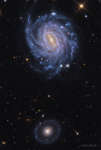 APOD: 2026 May 26 Б NGC 3660 and Burcins Galaxy
26.05.2026
The upper galaxy might be more photogenic, but the lower galaxy is more unusual. The galaxy up top is NGC 3660, a spiral galaxy similar to our own Milky Way galaxy in that it has several bright blue spiral arms and a central bar of stars, dust, and gas.
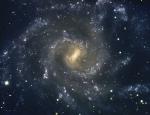 The Arms of NGC 7424
16.12.2004
The grand, winding arms are almost mesmerizing in this face-on view of NGC 7424, a spiral galaxy with a prominent central bar. About 40 million light-years distant in the headlong constellation Grus, this island universe is also about 100,000 light-years across making it remarkably similar to our own Milky Way.
|
January February March April May June July August September October |
|||||||||||||||||||||||||||||||||||||||||||||||||