
|
You entered: supernova
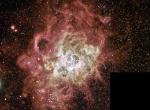 NGC 604: Giant Stellar Nursery
9.12.2003
Stars are sometimes born in the midst of chaos. About 3 million years ago in the nearby galaxy M33, a large cloud of gas spawned dense internal knots which gravitationally collapsed to form stars. NGC 604 was so large, however, it could form enough stars to make a globular cluster.
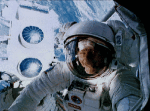 Releasing Compton
29.11.1995
Named for Nobel laureate physicist Arthur Holly Compton, the Compton Gamma Ray Observatory (CGRO) Satellite was launched in April of 1991 aboard the Space Shuttle Atlantis. CGRO's mission is to explore the Universe at gamma-ray energies.
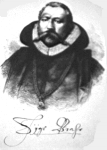 Tycho Brahe Measures the Sky
15.09.1996
Tycho Brahe was the most meticulous astronomical observer of his time. Brahe, who lived between 1546 and 1601, set out to solve the day's most pressing astronomical problem: to determine whether the Earth or the Sun was at the center of the Solar System.
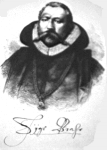 Tycho Brahe Measures the Sky
30.05.1999
Tycho Brahe was the most meticulous astronomical observer of his time. Brahe, who lived between 1546 and 1601, set out to solve the day's most pressing astronomical problem: to determine whether the Earth or the Sun was at the center of the Solar System.
 Tycho Brahe Measures the Sky
7.01.2001
Tycho Brahe was the most meticulous astronomical observer of his time. Brahe, who lived between 1546 and 1601, set out to solve the day's most pressing astronomical problem: to determine whether the Earth or the Sun was at the center of the Solar System.
 30 Doradus: The Tarantula Nebula
26.10.1999
30 Doradus is an immense star forming region in a nearby galaxy known as the Large Magellanic Cloud. Its spidery appearance is responsible for its popular name, the Tarantula Nebula, except that this tarantula is about 1,000 light-years across, and 165,000 light-years away in the southern constellation Dorado.
 30 Doradus Across the Spectrum
24.12.1997
30 Doradus is lit up like a Christmas tree. Shining in light across the electromagnetic spectrum, 30 Doradus glows because of all the energetic processes that go on there. A distinctive region visible...
 Two New Hubble Quality Telescopes Gifted to NASA
10.06.2012
What if you were given a new Hubble telescope for free? How about two? The astronomical community is abuzz with just this opportunity as the US National Reconnaissance Office has unexpectedly transferred ownership of two space-qualified Hubble-quality telescopes to NASA.
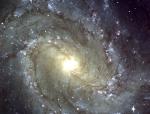 M83: The Southern Pinwheel Galaxy from VLT
6.12.1999
M83 is one of the closest and brightest spiral galaxies on the sky. Visible with binoculars in the constellation of Hydra, majestic spiral arms have prompted its nickname as the Southern Pinwheel. Although discovered...
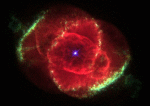 The Cat's Eye Nebula (Revisited)
4.07.1996
Three thousand light years away, a dying star throws off shells of glowing gas. This image from the Hubble Space Telescope reveals "The Cat's Eye Nebula" to be one of the most complex planetary nebulae known.
|
January February March April May June July August September October |
|||||||||||||||||||||||||||||||||||||||||||||||||