
|
You entered: supernova
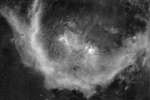 Barnards Loop around the Horsehead Nebula
23.02.2009
Why is the Horsehead Nebula surrounded by a bubble? Although hard to make out above, the famous Horsehead Nebula is the slight dark indentation in the bright streak just to the left of the image center. Glowing like an emission nebula, the origin of the bubble, known as Barnard's Loop, is currently unknown.
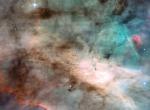 In the Center of the Omega Nebula
7.02.2004
In the depths of the dark clouds of dust and molecular gas known as the Omega Nebula, stars continue to form. The above image from the Hubble Space Telescope's Advanced Camera for Surveys shows exquisite detail in the famous star-forming region.
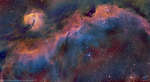 The Seagull Nebula
18.01.2023
A broad expanse of glowing gas and dust presents a bird-like visage to astronomers from planet Earth, suggesting its popular moniker - The Seagull Nebula. Using narrowband image data, this 3-panel mosaic of the cosmic...
 The Large Cloud of Magellan
6.09.2023
The 16th century Portuguese navigator Ferdinand Magellan and his crew had plenty of time to study the southern sky during the first circumnavigation of planet Earth. As a result, two fuzzy cloud-like objects easily...
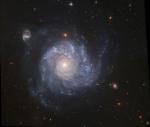 NGC 1309 and Friends
8.02.2006
A gorgeous spiral galaxy some 100 million light-years distant, NGC 1309 lies on the banks of the constellation Eridanus. NGC 1309 spans about 30,000 light-years, one third the size of our larger Milky Way galaxy.
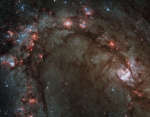 M83s Center from Refurbished Hubble
15.11.2009
What's happening at the center of spiral galaxy M83? Just about everything, from the looks of it. M83 is one of the closest spiral galaxies to our own Milky Way Galaxy and from a distance of 15 million light-years, appears to be relatively normal.
 IC 2574: Coddington's Nebula
5.02.2025
Grand spiral galaxies often seem to get all the glory, flaunting their young, bright, blue star clusters in beautiful, symmetric spiral arms. But small, irregular galaxies form stars too. In fact dwarf galaxy IC 2574 shows clear evidence of intense star forming activity in its telltale reddish regions of glowing hydrogen gas.
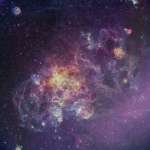 The Tarantula Zone
16.09.2009
The Tarantula Nebula is more than 1,000 light-years in diameter -- a giant star forming region within our neighboring galaxy the Large Magellanic Cloud (LMC). That cosmic arachnid lies left of center in this in this colorful telescopic image taken through narrow-band filters. It covers a part of the LMC over 2,000 light-years across.
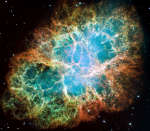 M1: The Crab Nebula from Hubble
25.12.2011
This is the mess that is left when a star explodes. The Crab Nebula, the result of a supernova seen in 1054 AD, is filled with mysterious filaments. The filaments are not only tremendously complex, but appear to have higher speed than expected from a free explosion.
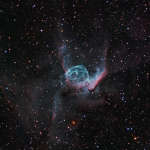 Thor s Helmet
7.03.2013
This helmet-shaped cosmic cloud with wing-like appendages is popularly called Thor's Helmet. Heroically sized even for a Norse god, Thor's Helmet is about 30 light-years across. In fact, the helmet is actually...
|
January February March April May June July August September October |
|||||||||||||||||||||||||||||||||||||||||||||||||