
|
You entered: supernova
 APOD: 2024 May 5 Б A Black Hole Disrupts a Passing Star
5.05.2024
What happens to a star that goes near a black hole? If the star directly impacts a massive black hole, then the star falls in completely -- and everything vanishes. More likely, though, the star goes close enough to have the black hole's gravity pull away its outer layers, or disrupt, the star.
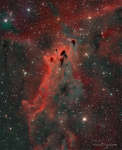 APOD: 2026 April 28 Б CG 30: Cometary Globules
28.04.2026
They're like mountain peaks, but they are forming stars. Bright-rimmed, flowing shapes gather near the center of this rich starfield toward the borders of the nautical southern constellations Puppis and Vela. Composed of interstellar gas and dust, the grouping of light-year sized cometary globules is about 1300 light-years distant.
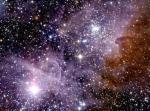 The Keyhole Nebula in Infrared
13.06.2000
About three million years ago, the stars in the Keyhole Nebula began to form. The above picture of the Keyhole Nebula, also known as the Carina Nebula or NGC 3372, shows in infrared light many facets of this dramatic stellar nursery which lies only 9,000 light-years away.
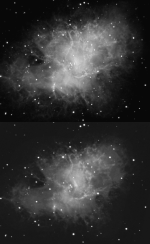 The Incredible Expanding Crab
27.12.2001
The Crab Nebula is cataloged as M1, the first on Charles Messier's famous list of things which are not comets. In fact, the Crab is now known to be a supernova remnant, an expanding cloud of debris from the explosion of a massive star.
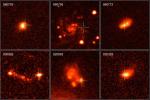 The Host Galaxies of Long Duration GRBs
17.05.2006
What causes the powerful explosions knows as gamma-ray bursts? Astrophysicists still aren't sure, but the longest duration gamma-ray bursts (GRBs) seem to involve very massive stars. A new clue indicating this was uncovered recently by a series of images taken by the orbiting Hubble Space Telescope.
 Explosions from White Dwarf Star RS Oph
26.07.2006
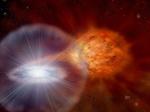
Spectacular explosions keep occurring in the binary star system named RS Ophiuchi. Every 20 years or so, the red giant star dumps enough hydrogen gas onto its companion white dwarf star to set off a brilliant thermonuclear explosion on the white dwarf's surface.
 Our Galaxy s Central Molecular Zone
10.11.2008
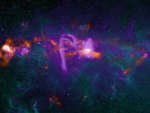
The central region of our Milky Way Galaxy is a mysterious and complex place. Pictured here in radio and infrared light, the galaxy's central square degree is highlighted in fine detail. The region is known as the Central Molecular Zone.
 M82: Starburst Galaxy with a Superwind
6.10.2011
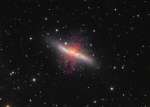
Also known as the Cigar Galaxy for its elongated visual appearance, M82 is a starburst galaxy with a superwind. In fact, through ensuing supernova explosions and powerful winds from massive stars, the burst of star formation in M82 is driving the prodigous outflow of material.
 A Spectre in the Eastern Veil
29.10.2014
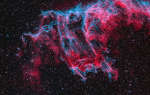
Frightening forms and scary faces are a mark of the Halloween season. They also haunt this cosmic close-up of the eastern Veil Nebula. The Veil Nebula itself is a large supernova remnant, the expanding debris cloud from the death explosion of a massive star.
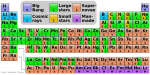 Where Your Elements Came From
25.01.2016
The hydrogen in your body, present in every molecule of water, came from the Big Bang. There are no other appreciable sources of hydrogen in the universe. The carbon in your body was made by nuclear fusion in the interior of stars, as was the oxygen.
|
January February March April May June July August September October |
|||||||||||||||||||||||||||||||||||||||||||||||||