
|
You entered: supernova
 Rumors of a Dark Universe
4.08.2019
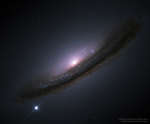
Twenty-one years ago results were first presented indicating that most of the energy in our universe is not in stars or galaxies but is tied to space itself. In the language of cosmologists, a large cosmological constant -- dark energy -- was directly implied by new distant supernova observations.
 APOD: 2024 April 3 Б Unusual Nebula Pa 30
3.04.2024
What created this unusual celestial firework? The nebula, dubbed Pa 30, appears in the same sky direction now as a bright "guest star" did in the year 1181. Although Pa 30's filaments look...
 The Crab Nebula in Blue and White
11.07.2000
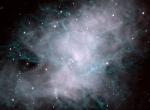
The Crab Nebula is a complex shell of expanding gas. The Crab Nebula formed from a star that was seen to explode in a supernova about 1000 years ago. This two color composite image taken with the WIYN 3.5-meter telescope shows in great detail filamentary structure of the glowing hydrogen gas.
 Moving Echoes Around SN 1987A
24.10.1997
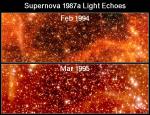
Yesterday's image highlighted reflective rings of light emitted by a supernova explosion. Today's pictures, taken over a year apart, highlight how these echoes are seen to move over time. Visible...
 Rumors of a Strange Universe
2.12.2001
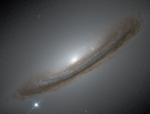
Three years ago results were first presented indicating that most of the energy in our universe is not in stars or galaxies but is tied to space itself. In the language of cosmologists, a large cosmological constant is directly implied by new distant supernovae observations.
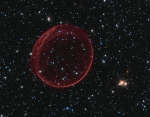 The Rippled Red Ribbons of SNR 0509
25.01.2011
What is causing the picturesque ripples of supernova remnant SNR 0509-67
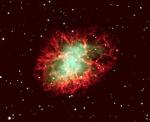 M1: Filaments of the Crab Nebula
7.02.1997
The Crab Nebula is filled with mysterious filaments. The Crab Nebula is the result of a star that exploded in 1054 AD. This spectacular supernova explosion was recorded by Chinese and (quite probably) Anasazi Indian astronomers.
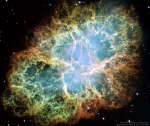 M1: The Crab Nebula from Hubble
9.09.2018
This is the mess that is left when a star explodes. The Crab Nebula, the result of a supernova seen in 1054 AD, is filled with mysterious filaments. The filaments are not only tremendously...
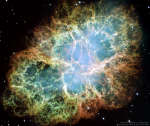 M1: The Crab Nebula from Hubble
6.09.2020
This is the mess that is left when a star explodes. The Crab Nebula, the result of a supernova seen in 1054 AD, is filled with mysterious filaments. The filaments are not only tremendously...
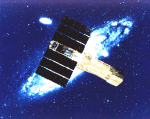 ASCA X-Ray Observatory
20.02.1996
Today marks the third anniversary of the launch of the Advanced Satellite for Cosmology and Astrophysics (ASCA; renamed from Astro D when launched). ASCA, seen here superposed on galaxy M31, is a Japanese satellite for which NASA has provided some scientific equipment. ASCA carries four large-area X-ray telescopes.
|
January February March April May June July August September October |
|||||||||||||||||||||||||||||||||||||||||||||||||