
|
You entered: HST
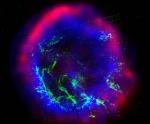 Supernova Remnant E0102 72 from Radio to X-Ray
14.04.2000
Not all stars form a big Q after they explode. The shape of supernova remnant E0102-72, however, is giving astronomers a clue about how tremendous explosions disperse elements and interact with surrounded gas. The above image is a composite of three different photographs in three different types of light.
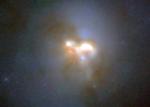 Arp 220: Spirals in Collision
17.06.1997
Arp 220 is the brightest object in the local universe. But why does it shine so brightly? Arp 220 was cataloged as a peculiar galaxy in the 1960s. In the late 1980s, it was discovered to be an ultraluminous infrared galaxy and headed a list compiled from observations with the now-defunct IRAS satellite.
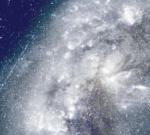 Bright Star Knots in NGC 4038
2.06.1997
This galaxy is having a bad millennium. In fact, the past 100 million years haven't been so good, and probably the next billion or so should be quite tumultuous. NGC 4039 was a normal spiral galaxy, minding its own business, when NGC 4038 crashed into it.
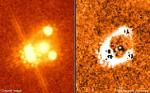 PG 1115: A Ghost of Lensing Past
2.11.1998
In this tangle of quasars and galaxies lies a clue to the expansion rate of the universe. A diffuse glow evident in the picture on the left reveals a normal elliptical galaxy. Directly behind this galaxy lies a normal quasar.
 Rumors of a Strange Universe
2.03.1998
In a meeting in California two weeks ago, unpublished results were presented indicating that most of the energy in our universe is not in stars or galaxies but is tied to space itself. In the language of cosmologists, a large cosmological constant is directly implied by new distant supernovae observations.
 Abell 2218: A Galaxy Cluster Lens
10.07.1995
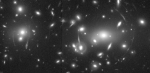
Sometimes one of the largest concentrations of mass known can act like a lens. Almost all of the bright objects in this image are galaxies in the cluster known as Abell 2218. The cluster...
 Asteroids in the Distance
16.03.1998
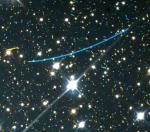
Rocks from space hit Earth every day. The larger the rock, though, the less often Earth is struck. Many kilograms of space dust pitter to Earth daily. Larger bits appear initially as a bright meteor. Baseball-sized rocks and ice-balls streak through our atmosphere daily, most evaporating quickly to nothing.
 Inside the Coma Cluster of Galaxies
16.06.2008
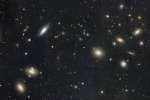
Almost every object in the above photograph is a galaxy. The Coma Cluster of Galaxies pictured above is one of the densest clusters known - it contains thousands of galaxies. Each of these galaxies houses billions of stars - just as our own Milky Way Galaxy does.
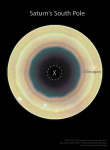 APOD: 2026 September 8 Б Hubble: Decagon Around Saturns South Pole
8.09.2026
Why are SaturnБs poles geometric? SaturnБs North Pole has been known to be surrounded by a hexagonal (6 sides) cloud since discovery in 1987 in data taken by NASAБs Voyager spacecrafts, which quickly flew past the ringed world in the early 1980s.
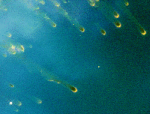 Cometary Knots in the Helix Nebula
16.04.1996
Four hundred fifty light-years from Earth, the wind from a dying, sun-like star produced a planetary nebula popularly known as the Helix. While exploring the Helix's gaseous envelope with the Hubble Space Telescope (HST), astronomers discovered indications of 1,000s of striking "cometary knots" like those shown above.
|
January February March April May June July August September October |
|||||||||||||||||||||||||||||||||||||||||||||||||