
|
You entered: HST
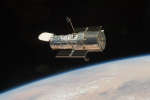 Hubble Floats Free
25.05.2009
Why put observatories in space? Most telescopes are on the ground. On the ground, you can deploy a heavier telescope and fix it more easily. The trouble is that Earth-bound telescopes must look through the Earth's atmosphere.
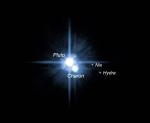 Nix and Hydra
24.06.2006
Discovered in mid-2005, Pluto's small moons were provisionally designated S/2005 P1 and S/2005 P2. They have now been officially christened Nix and Hydra. Compared to Pluto and its large moon Charon...
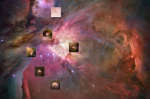 Planetary Systems Now Forming in Orion
22.12.2009
How do planets form? To help find out, the Hubble Space Telescope was tasked to take a detailed look at one of the more interesting of all astronomical nebulae, the Great Nebula in Orion.
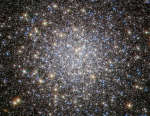 Hubble s Messier 5
4.11.2017
"Beautiful Nebula discovered between the Balance [Libra] & the Serpent [Serpens] ..." begins the description of the 5th entry in 18th century astronomer Charles Messier's famous catalog of nebulae and star clusters. Though it appeared...
 Rumors of a Dark Universe
4.08.2019
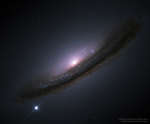
Twenty-one years ago results were first presented indicating that most of the energy in our universe is not in stars or galaxies but is tied to space itself. In the language of cosmologists, a large cosmological constant -- dark energy -- was directly implied by new distant supernova observations.
 Hubble s Messier 5
25.04.2014
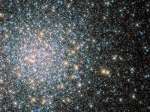
"Beautiful Nebula discovered between the Balance [Libra] & the Serpent [Serpens] ..." begins the description of the 5th entry in 18th century astronomer Charles Messier's famous catalog of nebulae and star clusters. Though it appeared...
 Hubble s Messier 5
20.06.2015
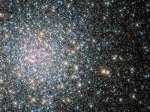
"Beautiful Nebula discovered between the Balance [Libra] & the Serpent [Serpens] ..." begins the description of the 5th entry in 18th century astronomer Charles Messier's famous catalog of nebulae and star clusters. Though it appeared...
 Webb and Hubble: IC 5332
26.02.2026
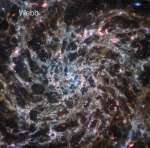
What does the universe look like through infrared goggles? Our eyes can only see visible light, but astronomers want to see more. TodayБs APOD shows spiral galaxy IC 5332 as seen by two NASA telescopes: Webb in mid-infrared and Hubble in ultraviolet and visible light.
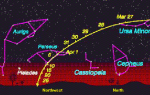 Comet Hyakutake Finder Chart for Early April
31.03.1996
During April Comet Hyakutake heads in toward the Sun after passing the Earth. At this time the comet's orbit places it north of the Earth. Remaining visible in the northern sky as it nears the Sun, it will set progressively earlier in the evening.
 Animation: Odd Radio Circles
30.03.2022
What do you call a cosmic puzzle that no one expected to see? In this case, Odd Radio Circles, aka ORCs. ORC-1 typifies the enigmatic five objects, only visible at radio frequencies, that were serendipitously discovered in 2019 using the new Australian SKA Pathfinder radio array.
|
January February March April May June July August September October |
|||||||||||||||||||||||||||||||||||||||||||||||||