
|
You entered: Observatory
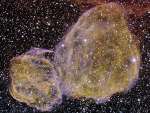 Double Supernova Remnants DEM L316
15.01.2008
Are these two supernova shells related? To help find out, the 8-meter Gemini Telescope located high atop a mountain in Chile was pointed at the unusual, huge, double-lobed cloud dubbed DEM L316. The resulting image, shown above, yields tremendous detail.
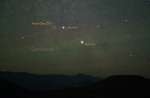 Naked Eye Nova Centauri 2013
7.12.2013
Brightest stellar beacons of the constellation Centaurus, Alpha and Beta Centauri are easy to spot from the southern hemisphere. For now, so is new naked eye Nova Centauri 2013. In this night skyscape recorded...
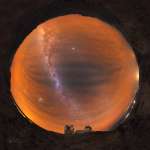 Milky Way vs Airglow Australis
17.05.2018
Captured last week after sunset on a Chilean autumn night, an exceptional airglow floods this allsky view from Las Campanas Observatory. The airglow was so intense it diminished parts of the Milky Way as it arced horizon to horizon above the high Atacama desert.
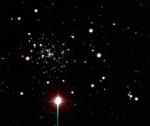 Palomar 13's Last Stand
30.11.2000
Globular star cluster Palomar 13 has roamed the halo of our Milky Way Galaxy for the last 12 billion years. The apparently sparse cluster of stars just left of center in this composite color digital image, it is one of the smallest, faintest globular clusters known.
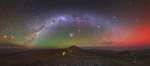 Milky Way with Airglow Australis
3.02.2017
Captured last April after sunset on a Chilean winter's night an exceptionally intense airglow flooded this scene. The panoramic skyscape is also filled with stars, clusters, and nebulae along the southern Milky Way including the Large and Small Magellanic clouds.
 APOD: 2024 May 28 Б Solar X Flare as Famous Active Region Returns
28.05.2024
It's back. The famous active region on the Sun that created auroras visible around the Earth earlier this month has survived its rotation around the far side of the Sun -- and returned. Yesterday...
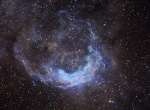 Windblown NGC 3199
22.05.2008
NGC 3199 lies about 12,000 light-years away, a glowing cosmic cloud in the southern constellation of Carina. The nebula is about 75 light-years across in this haunting, false-color view. Though the deep image...
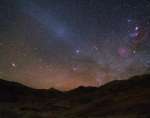 The Gegenschein Over Chile
14.01.2014
Is the night sky darkest in the direction opposite the Sun? No. In fact, a rarely discernable faint glow known as the gegenschein (German for "counter glow") can be seen 180 degrees around from the Sun in an extremely dark sky. The gegenschein is sunlight back-scattered off small interplanetary dust particles.
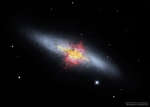 The Central Magnetic Field of the Cigar Galaxy
11.03.2019
Are galaxies giant magnets? Yes, but the magnetic fields in galaxies are typically much weaker than on Earth's surface, as well as more complex and harder to measure. Recently, though, the HAWC+ instrument...
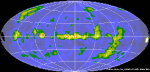 The COMPTEL Gamma-Ray Sky
29.05.1996
This premier gamma-ray view of the sky was produced by the COMPTEL instrument onboard NASA's orbiting Compton Gamma Ray Observatory. The entire sky is seen projected on a coordinate system centered on our Milky Way Galaxy with the plane of the Galaxy running across the middle of the picture.
|
January February March April May June July August September October |
|||||||||||||||||||||||||||||||||||||||||||||||||