
|
You entered: Observatory
 APOD: 2026 May 28 Б NGC 1514: The Crystal Ball Nebula
28.05.2026
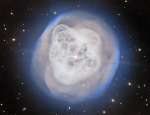
What do you see in this crystal ball? The featured image shows NGC 1514, known as the Crystal Ball Nebula, observed by the Gemini North telescope on Maunakea, in Hawai'i. NGC 1514 is 1,500 light-years away and was discovered by William Herschel in 1790.
 A Hale Bopp Holiday
25.12.1997
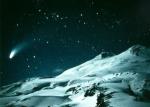
Seen from the Pik Terskol Observatory in the northern Caucasus mountains, comet Hale-Bopp and the bright stars of the constellation Perseus hang above the snowy, moon-lit landscape. Although it reminds Northern Hemisphere dwellers of an idyllic Winter scene, this picture was actually recorded in the spring - on April 13th of this year.
 APOD: 2026 September 4 Б Na Uhane Mahoe Huki Pu i ke Ola
4.09.2026
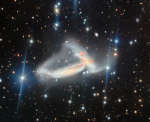
Nд йUhane Mдhoe Huki Pе i ke Ola, is the Hawaiian name given to this image of a pair of spiral galaxies locked in a mutual gravitational embrace. Some 200 million light-years distant toward...
 The Matter of Galaxy Clusters
24.10.2001
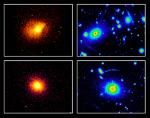
Situated over 2,000,000,000 (two billion) light-years from Earth, galaxies in cluster Abell 2390 (top) and MS2137.3-2353 (bottom) are seen in the right hand panels above, false-color images from the Hubble Space Telescope. Corresponding panels on the left reveal each cluster's x-ray appearance in images from the Chandra X-ray Observatory.
 The Complex Ion Tail of Comet Lovejoy
20.01.2015
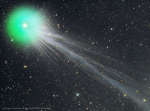
What causes the structure in Comet Lovejoy's tail? Comet C/2014 Q2 (Lovejoy), which is currently at naked-eye brightness and near its brightest, has been showing an exquisitely detailed ion tail. As the name...
 Full Earth, Full Moon
7.08.2015
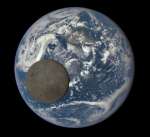
The Moon was new on July 16. Its familiar nearside facing the surface of planet Earth was in shadow. But on that date a million miles away, the Deep Space Climate Observatory (DSCOVR) spacecraft's Earth Polychromatic Imaging Camera (EPIC) captured this view of an apparently Full Moon crossing in front of a Full Earth.
 M16: Infrared Star Hunt
4.01.2002
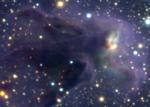
The head of an interstellar gas and dust cloud is shown here in false-color, a near-infrared view recorded by astronomers hunting for stars within M16's Eagle Nebula. Made famous in a 1995 Hubble...
 Comet Hyakutake's Closest Approach
24.03.1996
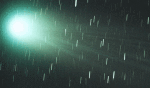
The above true color image of Comet Hyakutake was taken the night of March 21/22. Tonight, Comet Hyakutake will make its nearest approach to Earth, closing to a mere 10 million miles as it passes over the planet's Northern Hemisphere.
 Exceptional Rocket Waves Destroy Sun Dog
23.02.2010
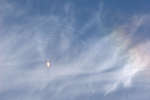
What created those rocket waves, and why did they destroy that sun dog? Close inspection of the above image shows not only a rocket rising near the center, but unusual air ripples around it and a colorful sundog to the far right.
 COMPTEL Explores The Radioactive Sky
24.07.1996
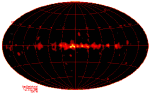
Diffuse gas clouds laced with radioactive aluminum atoms (Al26) line the plane of our Milky Way Galaxy! How do we see them? Relying on the Compton Effect, the COMPTEL instrument onboard NASA's immense orbiting Compton Gamma Ray Observatory can "see" the 1.8 million electron Volt gamma rays emitted by the radioactive decay.
|
January February March April May June July August September October |
|||||||||||||||||||||||||||||||||||||||||||||||||